

Collagen Side Effects: What the Research Actually Shows
The Short Answer: Hydrolysed collagen is a food protein. The individual trials that recorded adverse events, among them Proksch et al. (2014), Bolke et al. (2019) and Reilly et al. (2024), reported none attributable to it, and the minor effects reported are mild digestive discomfort in the first few days and, with some formats, an aftertaste. The points that need real attention are not the collagen. They are what sits alongside it in a comprehensive formula: fish allergen, vitamin A in pregnancy, and vitamin K alongside anticoagulant medicines. All three are covered below, in full.
What do the published trials report?
Pu et al. (2023) pooled 26 randomised controlled trials covering 1,721 participants taking hydrolysed collagen. Supplementation in those trials ran from 2 to 12 weeks. That review measured skin outcomes rather than safety, so it tells you how much collagen has been given and for how long, not what happened to the people taking it. For that you have to read the individual trials, and the ones that recorded it agree. Bolke et al. (2019) reported no adverse events in the collagen group; the only two events in the study, one case of nausea and one of heartburn, were in the placebo group. Reilly et al. (2024), at 8,000mg a day for 12 weeks, recorded no adverse events. Proksch et al. (2014), at 2,500mg and 5,000mg a day for 8 weeks, noted no side effects throughout the study.
Two qualifications belong with that record, and most articles leave them out. The trials were short, so they describe tolerability over weeks rather than safety over a lifetime. And almost every individual collagen trial is funded or supported by a collagen manufacturer. Pu is the exception, funded by an institutional grant from Wanfang Hospital. Read the funding line before you read the conclusion. That applies to our evidence as much as anyone else's.
Read more: Do Collagen Supplements Actually Work?
How much has actually been given in a trial?
The highest dose used in published skin research is 10,000mg a day. That figure is worth stating precisely, because a higher one circulates widely and is wrong. One systematic review lists Nomoto and Iizaka (2020) at 12 grams a day. The primary paper settles it: "Daily collagen peptide intake was 10.0 g in the intervention group." The same paper shows where the error came from: "Collagen peptides account for 10.0 g of 12.0 g of total protein contained in this product." A total protein figure was read as a collagen dose, and it has been repeated ever since.
Outside skin research, 15g a day has been given. Zdzieblik et al. (2015), Jendricke et al. (2019) and Kirmse et al. (2019) each used 15g a day in muscle and body composition trials, all of them funded or supported by the same collagen manufacturer. So Aura at 15,000mg sits above every dose used in published skin research, and level with a dose already used in published muscle research. It is not an untested quantity, and it is not a record-breaking one either.
Read more: 15,000mg Marine Collagen: Does Dose Actually Matter?
What minor effects do some people report?
Mild digestive discomfort is occasionally reported when starting any concentrated protein supplement. None of the trials cited here recorded it.
Aftertaste is format-dependent. Some liquid collagen products carry a marine or fishy aftertaste. This is a palatability issue rather than a physiological effect, and it depends on the flavouring system the manufacturer uses. Aura is apple flavoured and sugar-free, and includes organic raspberry, blueberry and red beet powders.
Read more: What Is in Aura? Every Ingredient Explained
Fish. This is the one with no workaround.
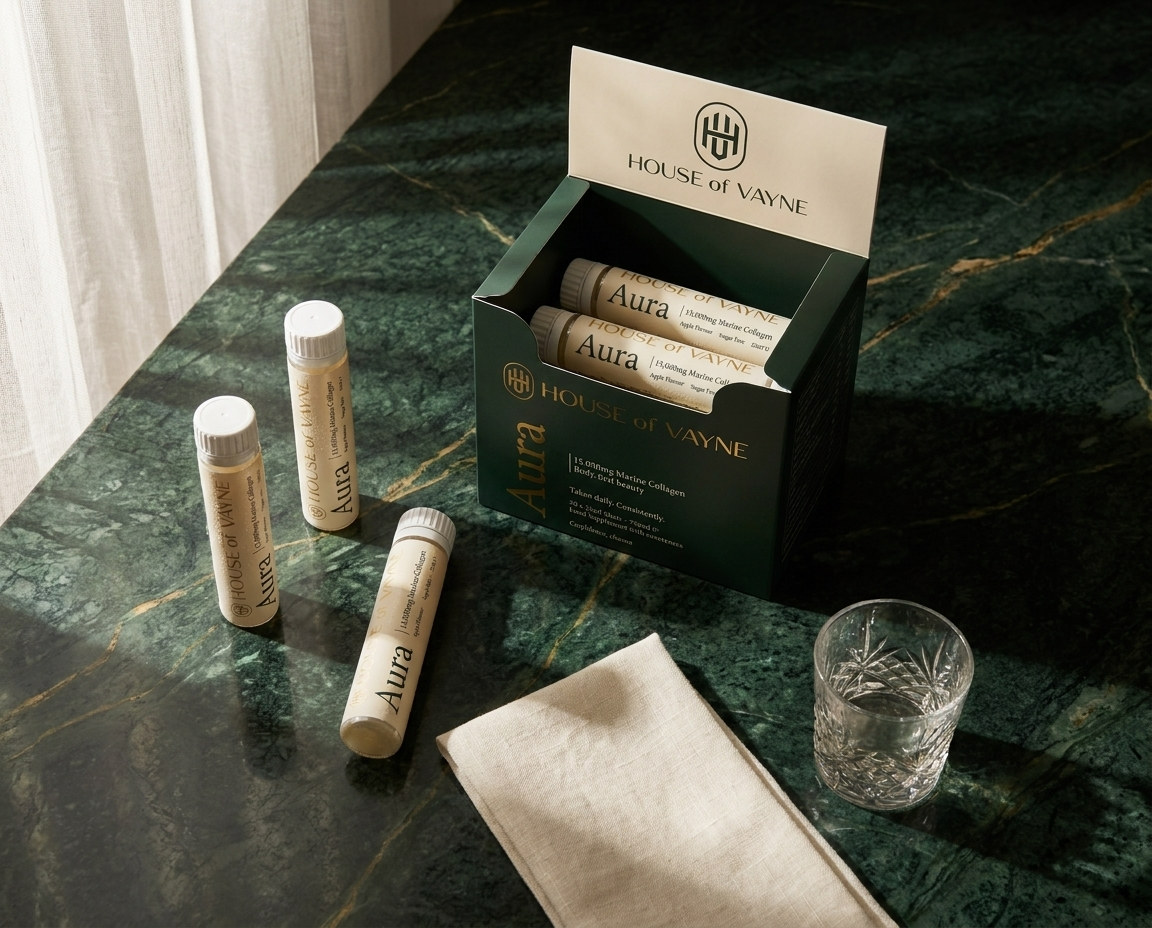
Aura contains fish. Marine collagen is made from fish, and hydrolysis is a processing step, not an allergen removal step. Fish protein may remain in the finished product. If you have a fish allergy, do not take Aura, and do not treat any marine collagen as safe on the basis that it has been hydrolysed. Aura is also not suitable for vegetarians or vegans for the same reason. The allergen is declared on the pack.
Vitamin A, and why pregnancy is a conversation with your doctor
This is about the supporting nutrients in a comprehensive formula, not about collagen. Aura contains 800µg of vitamin A per shot, as retinyl acetate. That is preformed retinol rather than beta-carotene, and the distinction matters. The NHS puts the amount of vitamin A adults aged 19 to 64 need at 700µg a day for men and 600µg a day for women.
NHS advice on supplements in pregnancy is direct: "Do not take cod liver oil or supplements containing vitamin A (sometimes called retinol) when you're pregnant. Too much vitamin A can harm your baby's development. Always check the label."
Aura's own label says the same thing in the standard form: women who are pregnant or planning a pregnancy should not take this product except on the advice of a doctor or antenatal clinic. If you are pregnant, trying to conceive, or breastfeeding, take the full ingredient list to your doctor or midwife and make the decision with them. Treat that as the instruction, not as a formality.
Vitamin K, and anticoagulant medicines
Aura contains 75µg of vitamin K2 per shot. Anticoagulant medicines such as warfarin are prescribed to slow blood clotting. Vitamin K is part of the clotting process, so a vitamin K supplement and an anticoagulant pull in opposite directions, and the supplement can work against the medicine.
NHS advice on warfarin is explicit: "Do not take the herbal remedy St John's wort or vitamin K supplements while you're taking warfarin."
If you take warfarin or any other anticoagulant, speak to your doctor or anticoagulant clinic before taking Aura, or any other supplement containing vitamin K. Read the full ingredient list first, because vitamin K appears in a great many comprehensive formulas without being flagged on the front of the pack.
Kidney disease, and total protein
Anyone with diagnosed kidney disease should speak to their doctor before taking any high-protein supplement, including collagen. The kidneys process excess amino acids, and people with reduced kidney function may need to manage total protein intake across the whole diet. This applies to protein supplements generally rather than to collagen specifically.
Read more: Marine Collagen vs Bovine Collagen: What the Research Actually Says
What about long-term use?
The published trials are short. Pu's pooled set ran from 2 to 12 weeks. That is long enough to describe tolerability over a season and not long enough to describe a decade. Anyone telling you that decades of safety data exist for collagen supplementation is going past the record.
What can be said is narrower, and still useful. Hydrolysed collagen is protein. It is digested into amino acids and peptides in the same way as protein from fish or meat. It is not a pharmacologically active compound.
The ceilings that matter on a comprehensive product sit with the vitamins and minerals, which is where they are worth checking on any brand. Aura's vitamin D3 is 35µg a shot. The NHS puts adult need at 10µg a day and advises: "Do not take more than 100 micrograms (4,000 IU) of vitamin D a day as it could be harmful." Aura sits between those two figures. Zinc is 10mg, vitamin K2 is 75µg, selenium is 27.5µg, vitamin A is 800µg. Every dose is printed on the pack, which is the whole point. You can only check what a brand is willing to print.
Read more: How Long Does Collagen Take to Work?
People Also Ask
Can collagen cause weight gain?
No trial has reported weight gain as an effect of collagen supplementation. A 15,000mg dose is 15g of protein, roughly what you would get from two eggs. Whether that matters depends on your diet as a whole rather than on collagen in particular.
Can collagen cause acne or breakouts?
There is no published evidence linking hydrolysed collagen to acne, and the trials measuring skin parameters did not report increased acne in the collagen groups. Reports of breakouts after starting a new supplement are common across the whole category and are hard to separate from other changes made at the same time.
Is collagen safe during pregnancy?
Collagen is a food protein. The question that actually needs answering is what else is in the product. Aura contains 800µg of preformed vitamin A per shot, and NHS advice is not to take supplements containing vitamin A during pregnancy. Women who are pregnant or planning a pregnancy should not take Aura except on the advice of a doctor or antenatal clinic. Take the ingredient list to your midwife or doctor and decide with them.
Can you take too much collagen?
Collagen is a protein rather than a nutrient with a set upper intake level, and no trial has reported harm at the doses tested, up to 15g a day. The ceilings that matter on a comprehensive product are the vitamins and minerals. Do not exceed the stated dose, and if you take other supplements alongside it, add up your total daily intake of each nutrient across all of them.
Read more: Marine Collagen in the UK
Key Takeaway: The published record on hydrolysed collagen itself is short but consistent: 26 randomised controlled trials, 1,721 participants, 2 to 12 weeks, and no adverse events attributed to it in the individual trials that recorded them. Almost all of that research is manufacturer-funded, which is worth knowing. The genuine cautions are not about collagen at all. They are fish allergen, vitamin A in pregnancy, vitamin K alongside anticoagulants, and total protein for anyone with kidney disease. If any of those four apply to you, speak to your doctor before starting.
References
Pu, S.Y. et al. (2023). "Effects of Oral Collagen for Skin Anti-Aging: A Systematic Review and Meta-Analysis." Nutrients, 15(9), 2080. PMC10180699. Source for the number of trials, the number of participants and the supplementation durations. This review measured skin outcomes and does not report adverse events.
Bolke, L. et al. (2019). "A Collagen Supplement Improves Skin Hydration, Elasticity, Roughness, and Density." Nutrients, 11(10), 2494. PMC6835901
Reilly, D. M. et al. (2024). "A Clinical Trial Shows Improvement in Skin Collagen, Hydration, Elasticity, Wrinkles, Scalp, and Hair Condition following 12-Week Oral Intake of a Supplement Containing Hydrolysed Collagen." Dermatology Research and Practice, 2024, 8752787. PMC11254459. Funded by Absolute Collagen.
Proksch, E. et al. (2014). "Oral Supplementation of Specific Collagen Peptides Has Beneficial Effects on Human Skin Physiology: A Double-Blind, Placebo-Controlled Study." Skin Pharmacology and Physiology, 27(1), 47-55. DOI: 10.1159/000351376
Nomoto, T. & Iizaka, S. (2020). "Effect of an Oral Nutrition Supplement Containing Collagen Peptides on Stratum Corneum Hydration and Skin Elasticity in Hospitalized Older Adults." Advances in Skin & Wound Care, 33(4), 186-191. PMID 32195722. PMC7328867
Zdzieblik et al. (2015). "Collagen peptide supplementation in combination with resistance training improves body composition and increases muscle strength in elderly sarcopenic men." British Journal of Nutrition, 114(8), 1237-1245. PMC4594048. Part-funded by Gelita AG.
Jendricke et al. (2019). "Specific Collagen Peptides in Combination with Resistance Training Improve Body Composition and Regional Muscle Strength in Premenopausal Women." Nutrients, 11(4), 892. PMC6521629. Part-funded by GELITA GmbH.
Kirmse et al. (2019). "Prolonged Collagen Peptide Supplementation and Resistance Exercise Training Affects Body Composition in Recreationally Active Men." Nutrients, 11(5), 1154. PMC6566878. Funded by Collagen Research Institute.
NHS. "Pregnancy vitamins and supplements." nhs.uk, accessed 22 August 2026.
NHS. "Warfarin." nhs.uk, accessed 22 August 2026.
NHS. "Vitamin A" and "Vitamin D", Vitamins and minerals. nhs.uk, accessed 22 August 2026.

,%20Bolke%20et%20al.%20(2019)%20and%20Reilly%20et%20al.%20(2024),%20reported...)
Leave a comment
This site is protected by hCaptcha and the hCaptcha Privacy Policy and Terms of Service apply.