

15,000mg Marine Collagen: does dose actually matter?
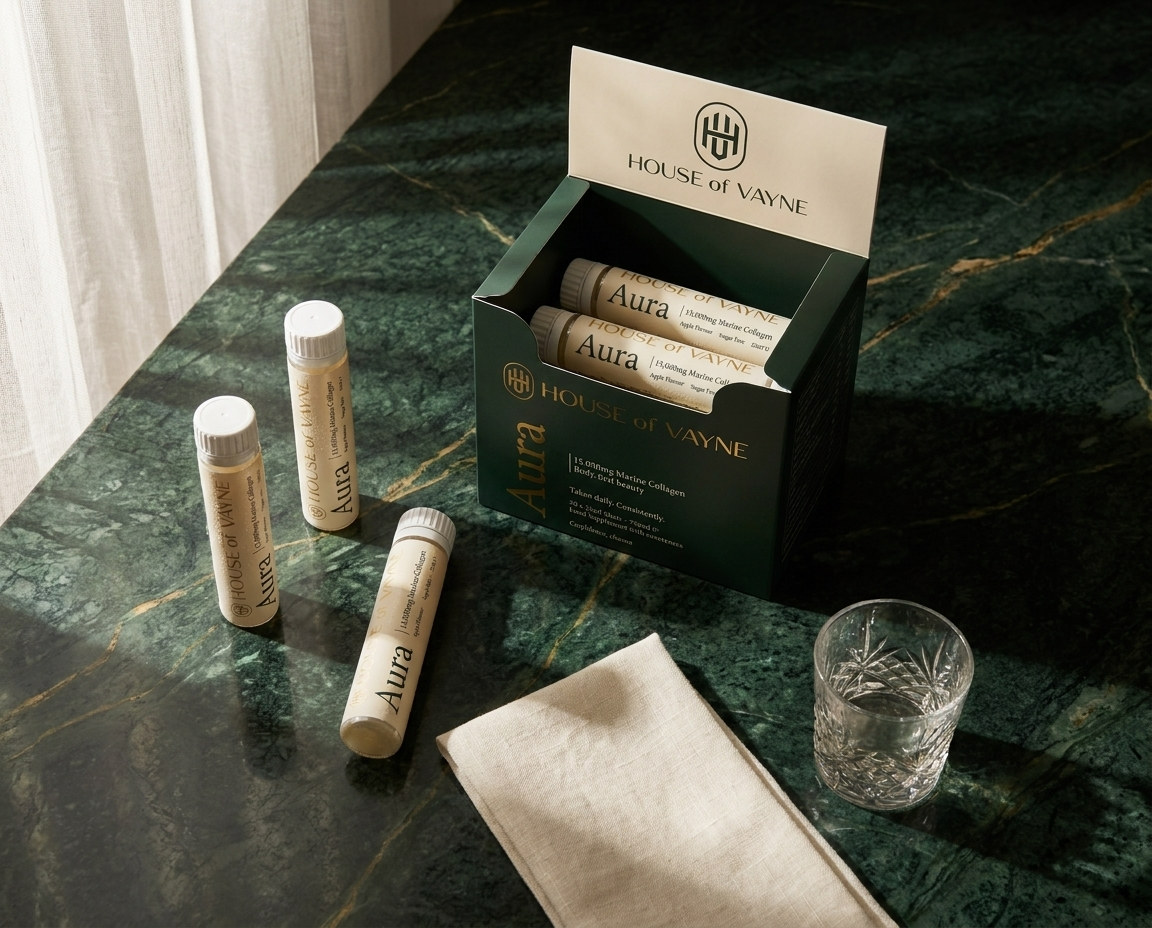
The Short Answer: Not in the way this category implies. No trial has ever compared one collagen dose against another for skin outcomes, so a dose-response relationship is not established and cannot honestly be claimed by anyone. What can be stated is what was tested, who paid for it, and what is in the bottle. Aura is 15,000mg of hydrolysed marine collagen per 25ml shot: more than any dose used in published skin research, and around twice the average dose across 72 UK collagen products surveyed in August 2026.
What doses have actually been tested?
Less tidily than the marketing suggests, and two of the numbers in wide circulation are wrong.
Start with the range. Pu et al. (2023) pooled 26 randomised controlled trials across 1,721 participants, and the doses in its own table run from 372mg a day at the bottom to 12g at the top. That 12g figure is itself an error carried in from one of the included studies, and the next section deals with it. Pu states no median dose anywhere, so any figure quoted as one has been invented. What the paper does give is the spread: 26 trials, 1,721 participants, study periods of 2 to 12 weeks, and a dose range that varies by a factor of roughly twenty-seven from bottom to top.
Then the ceiling. There is no 12g collagen trial. The figure comes from a transcription error that two reviews disagree about and the primary paper settles. Nomoto and Iizaka (2020) gave 10.0g of collagen peptides inside a product containing 12.0g of total protein, and the total protein figure was carried forward into a review table as though it were the dose. The primary paper is explicit: daily collagen peptide intake was 10.0g. So the ceiling of published skin research is 10,000mg a day.
And then the part almost nobody mentions. 15,000mg a day has been studied, three times, in Zdzieblik et al. (2015), Jendricke et al. (2019) and Kirmse et al. (2019). All three used exactly 15g a day. All three measured muscle and body composition rather than skin, and all three were funded by GELITA or the Collagen Research Institute. This matters for how the number gets used. Scoped to skin, 15,000mg genuinely is above every published dose. Unscoped, it merely matches a dose three trials have already used. The word skin is doing all the work, and any brand that drops it is saying something false.
Read more: How Long Does Collagen Take to Work?
Dose Comparison Table
| Dose | Duration | What was measured | Source | Who funded it |
|---|---|---|---|---|
| 15,000mg/day | 12 weeks | Muscle and body composition, not skin | Zdzieblik (2015); Jendricke (2019); Kirmse (2019) | GELITA and the Collagen Research Institute |
| 10,000mg/day | 8 to 12 weeks | Skin hydration and elasticity | Nomoto and Iizaka (2020), and four others | Nutri Co Ltd supplied products and equipment |
| 8,000mg/day | 12 weeks | Skin elasticity and hydration | Reilly et al. (2024) | Absolute Collagen, a collagen brand |
| 5,000mg/day | 8 weeks | Skin elasticity and hydration | Bianchi et al. (2022), 5g in the second month; Proksch et al. (2014), 5g arm | Lapi Gelatine |
| 2,500mg/day | 8 weeks | Skin elasticity and hydration | Proksch et al. (2014), 2.5g arm | Not recorded |
| 15,000mg/day | Not tested | No skin trial has been run at this dose | Aura by House of Vayne | Not applicable |
So does dose matter, or not?
Here is the honest answer, and it is narrower than either side of this argument would like.
No trial has compared one collagen dose against another for skin outcomes. Not one. The doses in the table above sit in separate studies, run by different teams, on different participants, using different products and different measuring equipment, and paid for by different manufacturers. They cannot be lined up and ranked, because they were never designed to be comparable. A bigger number in that column does not mean a bigger effect, and nothing in the table establishes that it does.
A pooled review does not fix that, and it is worth being clear about why. Pu et al. (2023) treats oral collagen as a single category and measures it against skin endpoints. Inside that category sit doses from 372mg to 10,000mg a day, products from different manufacturers, and study periods from 2 to 12 weeks. Pooling them produces one answer about collagen supplementation. It produces no answer at all about how much, and a dose-response curve read out of it has been supplied by the reader rather than found in the paper.
So why care about dose at all? Because it is the one thing on a label you can actually verify before you buy. You cannot verify what a brand tells you about your own skin. You can verify a milligram figure. That is a smaller reason to care than the category offers, and it has the advantage of being true.
Why are most collagen supplements thinly dosed?
Because collagen is the expensive part, and dose is where margin is made. Every additional gram costs the manufacturer money, and the supplement market is price-sensitive, so the commercial pressure runs in one direction. Proprietary blends make it easier still. A label reading collagen complex 5,000mg tells you the weight of the blend, not the weight of the collagen inside it, and the difference between those two numbers is where the decision is hidden.
The market data bears it out, though not evenly. A survey of 72 UK collagen products in August 2026 found a mean of 6,950mg per serving and a median of about 5,500mg. That average is carried almost entirely by powders, which averaged 11,285mg across 26 products. Liquid shots and sachets averaged 8,675mg across 20 products. Capsules and tablets averaged 1,547mg across 18. Gummies averaged 708mg across 8. The category average is not a real thing anyone buys. It is four different markets averaged together, and the gap between the top and the bottom is roughly sixteenfold.
Read more: Why Most Collagen Supplements Are Underdosed, And How to Tell
Read more: What Is in Aura? Every Ingredient Explained
Read more: Marine Collagen vs Bovine Collagen: What the Research Actually Says
How does Aura's dose compare?
Two comparisons, both of them checkable, neither of them a promise.
Against the research: 15,000mg is more than any dose used in published skin research, where the ceiling is 10,000mg a day. It is not more than any dose used in collagen research overall, for the reason set out above. A percentage against the research would imply a proportional benefit, and no evidence exists for one.
Against the market: 15,000mg is around twice the average dose across the 72 UK products surveyed in August 2026. Against liquids specifically it is 1.7 times the average. Against capsules and tablets it is closer to ten times. Which is precisely why a bare multiple with no stated basis is worthless. The basis is the claim: across 72 UK collagen products surveyed in August 2026 the mean dose was 6,950mg per serving, and that is the number the comparison is made against.
A box holds 30 shots, so 450,000mg of hydrolysed marine collagen. Aura is £85 a box, which is £2.83 a night, or £68 on subscription, which is £2.27. What the shot does about any of this has not been measured in anybody, at any dose, in any trial.
People Also Ask
Is 15,000mg too much collagen? Two separate things are on record, and they are worth keeping apart. Pu et al. (2023) describes what was tested: daily doses from 372mg up to 10,000mg against skin endpoints, over periods of 2 to 12 weeks. Pu did not pool adverse events at all, so it tells you nothing either way about tolerability, and any brand citing it for safety is citing a finding that is not there. The trials that did record one recorded it individually. Zdzieblik et al. (2015), at 15g a day for 12 weeks, reports that no serious adverse events were noted and no pathological findings appeared in routine blood tests. Proksch et al. (2014), at 2.5g and 5.0g a day for 8 weeks, reports that no side effects were noted throughout the study. That is a description of two trials, not an assurance about you. Aura contains fish. If you are pregnant, breastfeeding, taking medication, or have an allergy, speak to a doctor or pharmacist before starting any supplement.
Can I take a lower dose and get the same result? Nobody can answer that, because no study has compared two doses for skin outcomes. Anyone who gives you a confident answer in either direction is inventing it. What you can compare between two products is the milligram figure on the pack, and that is where a useful comparison stops.
How do I know my supplement has enough collagen? Enough for what is the problem with that question, because no threshold has been established. What you can do is find the actual number. Look for a milligram figure attached to the words hydrolysed collagen peptides, collagen hydrolysate, or hydrolysed marine collagen, rather than to a blend or a complex. If the label will not give you that figure, the reason is rarely a good one.
Key Takeaway: Dose is worth caring about because it is the one thing on a label you can verify, not because more has been shown to work better. No trial has compared two collagen doses for skin outcomes, so no dose-response relationship exists to point at. Aura is 15,000mg of hydrolysed marine collagen per 25ml shot: more than any dose used in published skin research, around twice the UK category average, and printed on the box.
References
Pu, S.Y. et al. (2023). "Effects of Oral Collagen for Skin Anti-Aging: A Systematic Review and Meta-Analysis." Nutrients, 15(9), 2080. PMC10180699. Funded by an institutional grant, Taipei Medical University.
Nomoto, T. and Iizaka, S. (2020). "Effect of an Oral Nutrition Supplement Containing Collagen Peptides on Stratum Corneum Hydration and Skin Elasticity in Hospitalized Older Adults." Advances in Skin and Wound Care, 33(4), 186-191. PMC7328867. Test products and equipment supplied by Nutri Co Ltd.
Zdzieblik, D. et al. (2015). "Collagen peptide supplementation in combination with resistance training improves body composition and increases muscle strength in elderly sarcopenic men: a randomised controlled trial." British Journal of Nutrition, 114(8), 1237-1245. PMC4594048. Part-funded by Gelita AG.
Jendricke, P. et al. (2019). "Specific Collagen Peptides in Combination with Resistance Training Improve Body Composition and Regional Muscle Strength in Premenopausal Women: A Randomized Controlled Trial." Nutrients, 11(4), 892. PMC6521629. Part-funded by GELITA GmbH.
Kirmse, M. et al. (2019). "Prolonged Collagen Peptide Supplementation and Resistance Exercise Training Affects Body Composition in Recreationally Active Men." Nutrients, 11(5), 1154. PMC6566878. Supported by the Collagen Research Institute.
Reilly, D. M. et al. (2024). "A Clinical Trial Shows Improvement in Skin Collagen, Hydration, Elasticity, Wrinkles, Scalp, and Hair Condition following 12-Week Oral Intake of a Supplement Containing Hydrolysed Collagen." Dermatology Research and Practice, 2024, 8752787. PMC11254459. Funded by Absolute Collagen; all five authors are Absolute Collagen employees.
Bianchi, F. M. et al. (2022). "Evaluation of the Efficacy of a Hydrolyzed Collagen Supplement for Improving Skin Moisturization, Smoothness, and Wrinkles." Journal of Clinical and Aesthetic Dermatology, 15(3), 48-52. PMC8944283. Funded by Lapi Gelatine.
Proksch, E. et al. (2014). "Oral Supplementation of Specific Collagen Peptides Has Beneficial Effects on Human Skin Physiology: A Double-Blind, Placebo-Controlled Study." Skin Pharmacology and Physiology, 27(1), 47-55. DOI: 10.1159/000351376
House of Vayne UK collagen dose survey, August 2026. 72 UK collagen products, each dose verified against a live product page.

Leave a comment
This site is protected by hCaptcha and the hCaptcha Privacy Policy and Terms of Service apply.