

Article: How Long Does Collagen Take to Work?
How Long Does Collagen Take to Work?
The Short Answer: There is no collagen timeline. What exists is a set of trials that ran for 8 to 12 weeks, almost all of them paid for by collagen manufacturers. What matters is what was measured, over what period, by whom, and why the number you have been quoted is a study length rather than a promise.
What did the trials actually measure, and for how long?
The research in this field measures skin with instruments rather than opinions. Corneometry for hydration of the outer skin layer, cutometry for an elasticity index, and in some studies ultrasound for dermal density. Participants are randomised, the product and the placebo are blinded so that neither the participant nor the assessor knows which is which, and readings are taken at the start and again at the end.
The durations cluster tightly. Pu et al. (2023), pooling 26 randomised controlled trials across 1,721 participants, records that its included studies ran from 2 to 12 weeks. Bolke et al. (2019) ran 12 weeks, with a further reading four weeks after intake stopped. Reilly et al. (2024) ran 12 weeks. Bianchi et al. (2022) ran 56 days.
That is where 8 to 12 weeks comes from. It is the length of time researchers chose to run their studies. It is not a finding about when a particular person notices anything, and no paper presents it as one. The number travelled out of a methods section into marketing copy and picked up a meaning along the way that it does not have.
Read more: What Collagen Actually Does for Your Skin, Hair and Nails
Why can nobody give you a date?
Two reasons. The first is the quality of the evidence. The second is you.
The evidence is thinner than its volume suggests. Every individual trial cited at the foot of this article is manufacturer-funded or manufacturer-supported. The trials are also small against the claims built on them. The three individual trials cited here analysed 52, 72 and 130 participants, the demographics are rarely representative of the people the advertising is aimed at, and the thing measured in the study is frequently not the thing quoted in the copy: a trial that measured moderate to deep wrinkles ends up cited in advertising about fine lines. Holding a study and being able to stand behind what you say about it are two different things, and the difference sits in detail that rarely reaches the front of a box.
And then there is you. A trial reports an average across a group. An average is not a prediction about any one person inside it, let alone about someone who was never in it. Age, diet, sleep, sun exposure, hormonal status and genetics all differ, and nothing in this literature was designed to forecast an individual result. Anyone who tells you otherwise is guessing with confidence.
So what actually matters?
Consistency, for an unglamorous reason. Every trial that reported anything gave its participants a fixed daily dose for the whole study period. Nobody has studied taking a collagen supplement three times one week and not at all the next, because there would be nothing to measure. Whatever the honest ceiling of this category turns out to be, a product that sits unopened will not reach it.
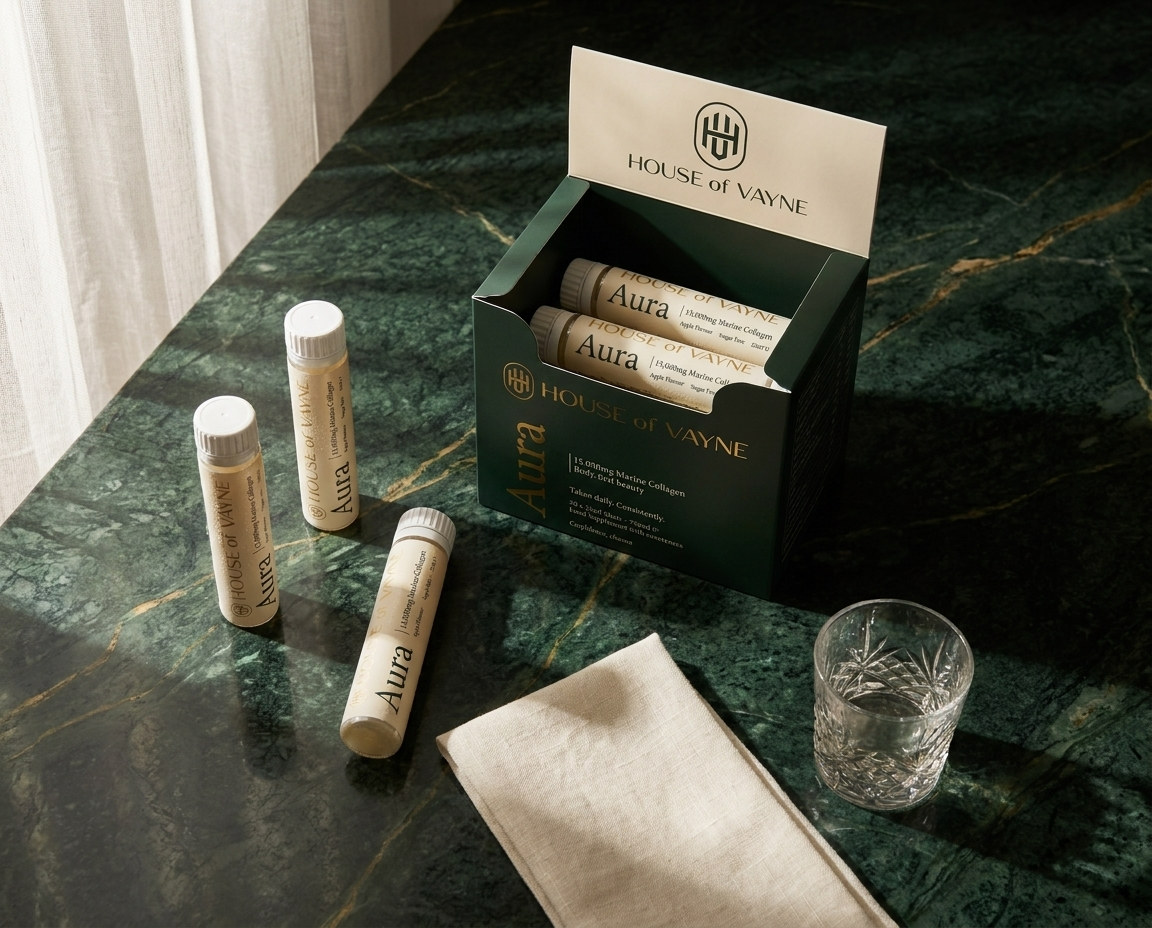
That is a behavioural problem rather than a biological one, and it is the reason Aura is a 25ml shot rather than a powder. Nothing to weigh, nothing to mix, nothing half-used at the back of a cupboard. A fixed dose taken at a fixed point in the day is the easiest kind of habit to hold on to. It is convenience, and convenience is the argument for the format.
Read more: What Is in Aura? Every Ingredient Explained
Why the evening, then?
Because a ritual needs a fixed point, and the end of the day is the one most people already keep. The serums, the SPF, the early nights. There is an existing sequence to attach to, and attaching to an existing sequence is what makes a new habit hold.
If mornings suit you better, take it in the morning. Taking it at the same time is the only part of this worth arguing for.
Read more: Collagen After 30: Why Your Skin Needs More Than Skincare
What is in the shot, and at what dose
One piece of background first. Collagen production begins to decline from the mid-twenties, at an estimated rate of 1 to 1.5% per year (Reilly and Lozano, 2021), accelerating after menopause (Viscomi et al., 2025). That is well documented in the peer-reviewed literature.
Five of the 12 actives relate to skin, hair or nails, and each line belongs to the nutrient named in it. Vitamin C contributes to normal collagen formation for the normal function of skin. Vitamin A contributes to the maintenance of normal skin. Biotin contributes to the maintenance of normal skin, and to the maintenance of normal hair. Zinc contributes to the maintenance of normal skin, to the maintenance of normal hair, and to the maintenance of normal nails. Selenium contributes to the maintenance of normal hair, and to the maintenance of normal nails.
Two things in that list are worth pausing on, because the category gets both wrong routinely. Biotin belongs with skin and hair, not with nails. Selenium belongs with hair and nails, not with skin. So the familiar phrase attaching biotin and selenium to skin, hair and nails alike puts two of them in the wrong place. And the vitamin C line concerns the collagen your own body forms. It is not about the marine collagen in the shot, and it should never be presented as though it were.
Marine collagen, hyaluronic acid, MSM, elastin and astaxanthin are in the shot at these doses. Marine collagen, 15,000mg, Types I and III. Hyaluronic acid, 50mg. MSM, 200mg. Elastin, 10mg. Astaxanthin, 2mg.
Read more: 15,000mg Marine Collagen: Does Dose Actually Matter?
People Also Ask
Can I see results faster than 8 to 12 weeks? Nobody can tell you that you will see a result at all, on any timescale, and 8 to 12 weeks is a study length rather than a threshold that has been crossed or missed. If a brand offers you a faster number, the useful question is what that number was measured against, and the usual answer is nothing.
What happens if I stop taking it? Supplementation ends, so the intake ends. What is documented separately is the underlying physiology: collagen production declines from the mid-twenties at an estimated 1 to 1.5% per year, whether or not anyone is supplementing.
Does it matter what time in the evening I take it? Not for any reason the research supports. Pick a point you will actually keep to, and keep to it. Thirty to sixty minutes before bed suits most people simply because there is already a routine there to attach it to.
Why do some brands claim results in two weeks? Because it sells. The durations in this literature are study lengths, not thresholds, so a two week promise and a twelve week promise rest on the same thing: somebody's decision about how long to run a trial, rather than a finding about when anyone notices anything. The two week version is simply more obvious about it.
Key Takeaway: There is no collagen timeline, only trial durations, and 8 to 12 weeks is the second of those dressed up as the first. No brand can honestly promise you a result by a date. What is left is worth more than the promise was: a stated dose, printed on the box, taken at the same time each day. Aura is 15,000mg of hydrolysed marine collagen with 12 actives, in a single 25ml shot.
References
Pu, S.Y. et al. (2023). "Effects of Oral Collagen for Skin Anti-Aging: A Systematic Review and Meta-Analysis." Nutrients, 15(9), 2080. PMC10180699. Funded by Taipei Municipal Wanfang Hospital, managed by Taipei Medical University, grant 111TMU-WFH-06.
Bolke, L. et al. (2019). "A Collagen Supplement Improves Skin Hydration, Elasticity, Roughness, and Density: Results of a Randomized, Placebo-Controlled, Blind Study." Nutrients, 11(10), 2494. PMC6835901. Funded by Quiris Healthcare.
Reilly, D. M. et al. (2024). "A Clinical Trial Shows Improvement in Skin Collagen, Hydration, Elasticity, Wrinkles, Scalp, and Hair Condition following 12-Week Oral Intake of a Supplement Containing Hydrolysed Collagen." Dermatology Research and Practice, 2024, 8752787. PMC11254459. Funded by Absolute Collagen; all authors but one are Absolute Collagen employees.
Bianchi, F. M. et al. (2022). "Evaluation of the Efficacy of a Hydrolyzed Collagen Supplement for Improving Skin Moisturization, Smoothness, and Wrinkles." Journal of Clinical and Aesthetic Dermatology, 15(3), 48-52. PMC8944283. Funded by Lapi Gelatine.
Reilly, D. M. and Lozano, J. (2021). "Skin collagen through the lifestages: importance for skin health and beauty." Plastic and Aesthetic Research, 8, 2. DOI: 10.20517/2347-9264.2020.153. Both authors work for Minerva Research Labs, which produces collagen-based supplements.
Viscomi, B., Muniz, M. and Sattler, S. (2025). "Managing Menopausal Skin Changes: A Narrative Review of Skin Quality Changes, Their Aesthetic Impact, and the Actual Role of Hormone Replacement Therapy in Improvement." Journal of Cosmetic Dermatology, 24(Suppl 4), e70393. PMC12374573

Leave a comment
This site is protected by hCaptcha and the hCaptcha Privacy Policy and Terms of Service apply.