

What is in Aura
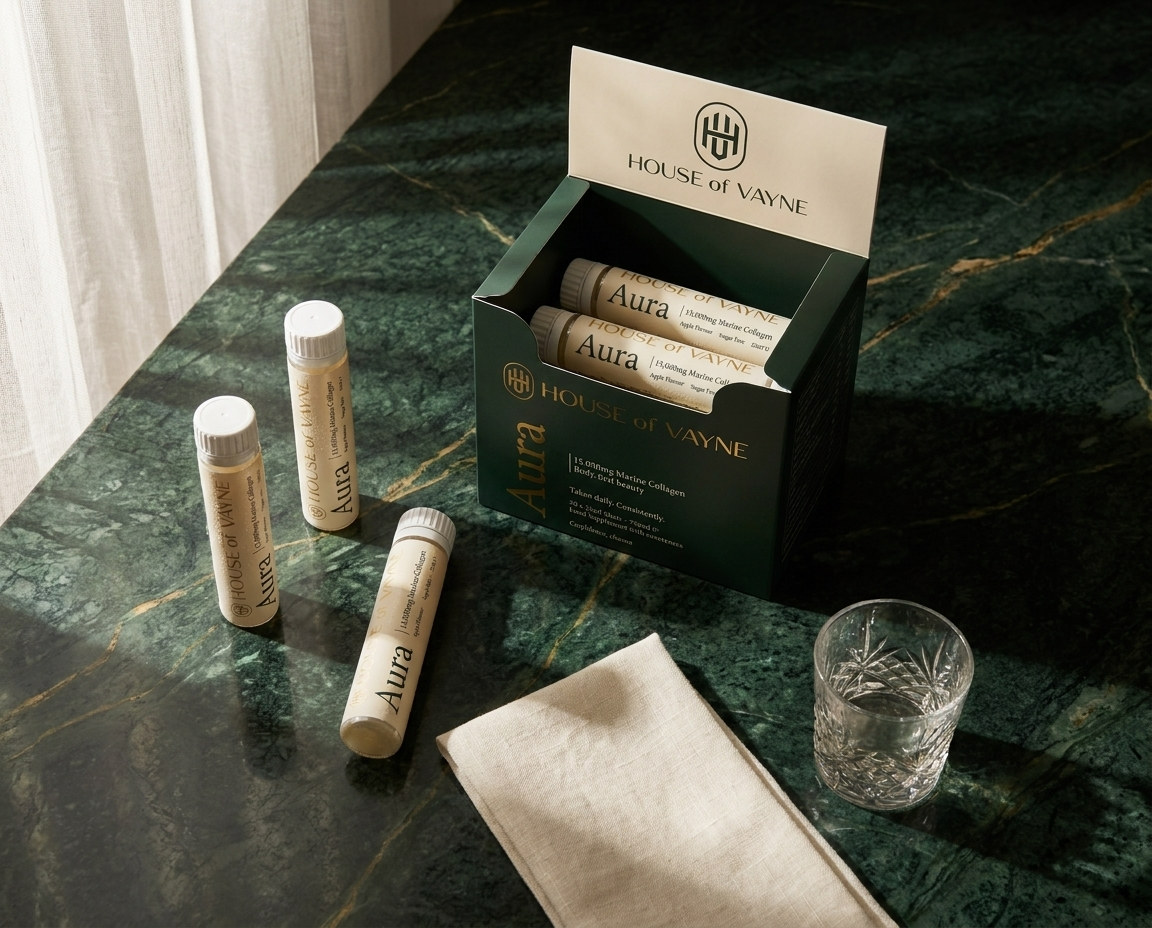
Aura is 15,000mg of hydrolysed marine collagen, Types I and III, plus 12 actives, in a 25ml shot. Every dose is printed on the pack. The collagen is not counted as one of the 12, and neither are the fruit powders.
The collagen
15,000mg of hydrolysed marine collagen per shot, Types I and III, sourced from fish. Type I is the main collagen in skin, at 80 to 90 per cent of skin collagen, and marine collagen is extracted from fish skin and scale, which is why marine is the source used here.
Hydrolysis is the processing step that matters. Hydrolysed collagen is broken down into low-molecular-weight peptides that are absorbed into the bloodstream after oral intake. That is the mechanism, and it is as far as the evidence goes. There is no published human study comparing collagen absorption between a liquid and a tablet, in either direction, so nobody can honestly claim an advantage for a format. What a pre-mixed shot does give you is a fixed 15,000mg with no measuring and no mixing, which is a point about behaviour rather than biology.
Read more: Marine Collagen vs Bovine Collagen: What the Research Actually Says
On dose, the position is straightforward. The highest dose used in published skin research is 10,000mg a day. Aura delivers 15,000mg per shot, more than any dose used in published skin research, and around twice the average dose across the 72 UK collagen products surveyed in August 2026, which came out at a mean of 6,950mg. No trial has compared one dose against another for skin outcomes.
Read more: 15,000mg Marine Collagen: Does Dose Actually Matter?
The eight vitamins and minerals
Vitamin C, 120mg, 150% NRV. Vitamin C contributes to normal collagen formation for the normal function of skin, to the protection of cells from oxidative stress, to the normal function of the immune system, to the reduction of tiredness and fatigue and to normal psychological function.
Vitamin A, 800µg, 100% NRV, as retinyl acetate. Vitamin A contributes to the maintenance of normal skin and normal vision, and to the normal function of the immune system. This is preformed retinol rather than beta-carotene, which is why anyone who is pregnant, planning a pregnancy or breastfeeding should speak to their doctor or midwife before taking Aura. That point is covered properly in our article on collagen side effects.
Biotin, 450µg, 900% NRV. Biotin contributes to the maintenance of normal hair and skin, to normal energy-yielding metabolism, to normal psychological function and to normal functioning of the nervous system. Biotin belongs with hair and skin. Not with nails, whatever the rest of the category prints on the front of the box.
Zinc, 10mg, 100% NRV. Zinc contributes to the maintenance of normal skin, hair, nails, vision and bones, to normal cognitive function, to the normal function of the immune system and to the protection of cells from oxidative stress.
Selenium, 27.5µg, 50% NRV. Selenium contributes to the maintenance of normal hair and nails, to the normal function of the immune system and to the protection of cells from oxidative stress. Selenium belongs with hair and nails, and not with skin.
Vitamin D3, 35µg, 700% NRV. Vitamin D contributes to the normal function of the immune system and to the maintenance of normal bones, normal teeth and normal muscle function.
Vitamin K2, 75µg, 100% NRV. Vitamin K contributes to the maintenance of normal bones. Anyone taking warfarin or another anticoagulant should speak to their doctor before taking any supplement containing vitamin K.
Vitamin B5, 12mg, 200% NRV. Pantothenic acid contributes to the reduction of tiredness and fatigue, to normal energy-yielding metabolism and to normal mental performance.
Read more: What Collagen Actually Does for Your Skin, Hair and Nails
The four remaining actives, by name and dose
These four are in the formula at doses you can read off the pack.
MSM, 200mg. An organic sulphur compound, methylsulfonylmethane.
Hyaluronic acid, 50mg, as sodium hyaluronate. A glycosaminoglycan.
Elastin, 10mg. A structural protein.
Astaxanthin, 2mg. A carotenoid.
Every active, every dose
| Ingredient | Dose per 25ml shot | NRV% | How it is listed |
|---|---|---|---|
| Hydrolysed marine collagen, Types I and III | 15,000mg | N/A | Name and dose |
| Vitamin C (L-ascorbic acid) | 120mg | 150% | Name, dose and function |
| Vitamin A (retinyl acetate) | 800µg | 100% | Name, dose and function |
| Biotin (vitamin B7) | 450µg | 900% | Name, dose and function |
| Vitamin D3 (cholecalciferol) | 35µg | 700% | Name, dose and function |
| Vitamin K2 | 75µg | 100% | Name, dose and function |
| Vitamin B5 (pantothenic acid) | 12mg | 200% | Name, dose and function |
| Zinc (zinc gluconate) | 10mg | 100% | Name, dose and function |
| Selenium (sodium selenite) | 27.5µg | 50% | Name, dose and function |
| MSM (methylsulfonylmethane) | 200mg | N/A | Name and dose |
| Hyaluronic acid (sodium hyaluronate) | 50mg | N/A | Name and dose |
| Elastin | 10mg | N/A | Name and dose |
| Astaxanthin | 2mg | N/A | Name and dose |
| Organic raspberry, blueberry and red beet powders | 5mg each | N/A | Fruit and vegetable powders, used for colour. Not counted as actives. |
Why the count is 12, and not a bigger number
Because the collagen is not an active alongside itself, and the fruit powders are colour at 5mg each. A brand wanting a larger headline could count all of them and reach 16. Aura is marine collagen plus 12 actives. If the number moves depending on where it is printed, it was never a specification.
Read more: How Long Does Collagen Take to Work?
People Also Ask
Why doesn't Aura contain vitamin E?
Because the formula is built around depth rather than breadth. Vitamin E is widely available from ordinary food, including nuts, seeds and vegetable oils. Adding it would lengthen the label and add cost without adding to what this product is for. A long ingredient list at trace doses is easier to sell than a short one at full doses, which is precisely why so many products have one.
Is the vitamin D3 dose of 700% NRV safe?
Aura contains 35µg of vitamin D3 a shot. NHS guidance is that adults need 10µg a day, and that you should "not take more than 100 micrograms (4,000 IU) of vitamin D a day as it could be harmful". Aura sits between the two. If you already take a separate vitamin D supplement, add the two together before you start, and do the same for vitamin A, vitamin C, vitamin B5, biotin, vitamin K and zinc, all of which Aura provides at 100% NRV or more.
Can I take Aura if I have a fish allergy?
No. Aura contains marine collagen derived from fish, and fish is declared as an allergen on the pack. Hydrolysis is a processing step, not an allergen removal step, so fish protein may remain in the finished product. Aura is not suitable for vegetarians or vegans for the same reason.
Read more: Collagen After 30: Why Your Skin Needs More Than Skincare
Are there any artificial additives?
There are some, and they are on the label rather than hidden in it. Aura contains sweeteners (steviol glycosides, sucralose and acesulfame K), a freshness preserver (potassium sorbate and sodium benzoate), acidity regulators (citric acid and malic acid), and natural apple flavour. Colour comes from organic raspberry, blueberry and red beet powders rather than a synthetic colouring. So Aura is not preservative-free. It is sugar-free, and free from wheat, gluten, soya, egg, nuts and milk.
Aura is 15,000mg of hydrolysed marine collagen plus 12 actives, every dose printed. Eight of those actives have a stated function. Four are listed by what they are and how much is in the shot. That split is the honest shape of this category, and most labels are built to hide it.
References
Swedish Nutra. Product specification, Marine Collagen 15 000 mg, 25ml dose. Manufacturer ingredient and dose specification for Aura.
Reilly, D.M. & Lozano, J. (2021). Skin collagen through the lifestages: importance for skin health and beauty. Plastic and Aesthetic Research, 8, 2. DOI: 10.20517/2347-9264.2020.153. Both authors work for Minerva Research Labs, which produces collagen-based supplements.
Leon-Lopez et al. (2019). Hydrolyzed collagen: sources and applications. Molecules, 24(22), 4031. PMC6891674.
Coppola, D., Oliviero, M., Vitale, G. A., et al. (2020). Marine collagen from alternative and sustainable sources: extraction, processing and applications. Marine Drugs, 18(4), 214. PMC7230273.
Virgilio et al. (2024). Absorption of bioactive peptides following collagen hydrolysate intake: a randomized, double-blind crossover study in healthy individuals. Frontiers in Nutrition, 11, 1416643. PMC11325589. Funded by Rousselot BV.
Nomoto, T. & Iizaka, S. (2020). Effect of an oral nutrition supplement containing collagen peptides on stratum corneum hydration and skin elasticity in hospitalized older adults. Advances in Skin & Wound Care, 33(4), 186-191. PMC7328867.
House of Vayne UK collagen dose survey, August 2026. 72 UK collagen products, each dose verified against a live product page.
NHS. "Vitamin D", Vitamins and minerals. nhs.uk, accessed 21 August 2026.

Leave a comment
This site is protected by hCaptcha and the hCaptcha Privacy Policy and Terms of Service apply.