Skip to content

Cart

Your cart is empty

Article: Collagen after 30

Collagen after 30

By age 30, you have already lost approximately 5-7.5% of your dermal collagen — and the decline accelerates from here. Topical skincare works on the epidermis (surface), but cannot penetrate deep enough to replace the structural collagen being lost in the dermis. Oral supplementation provides the building blocks from the inside.

How much collagen have you actually lost by 30?

Varani et al. (2006), an NIH-funded study from the University of Michigan, established that collagen decline begins around the mid-twenties and proceeds at approximately 1-1.5% per year. This means that by age 30, you have already lost roughly 5-7.5% of your dermal collagen cumulative. This is not a small number. It represents a meaningful reduction in the structural protein that gives skin its elasticity, firmness, and resilience.

Read more: What Collagen Actually Does for Your Skin, Hair and Nails

Shuster et al. (1975) confirmed the relationship between age, sex, and skin thickness, demonstrating that skin thickness declines progressively with age in both men and women. The loss is not uniform — sun exposure and environmental damage accelerate it in exposed areas like the face, hands, and neck. This is why sun-exposed skin often shows more visible signs of aging than sun-protected areas.

By age 40, collagen loss reaches 15-22.5%. By age 50, it reaches 25-37.5%. But the trajectory accelerates dramatically in women after menopause, when collagen loss increases to approximately 2.1% per year as oestrogen levels drop. This acceleration explains why many women report visible skin changes during and after menopause despite maintaining the same skincare routine. The loss is happening at twice the rate it was before, and no topical product can reverse a loss of structural protein this significant.

Read more: Marine Collagen vs Bovine Collagen: What the Research Actually Says

These are not abstract percentages. They translate to visible, tactile changes: thinner skin that bruises more easily, reduced bounce-back after pinching or compression, fine lines becoming static wrinkles that do not disappear when skin relaxes, and skin that takes considerably longer to recover from temporary dehydration or sun exposure. The structural foundation of your skin is literally becoming thinner and weaker.

Why can topical skincare not replace lost collagen?

The epidermis — the outermost layer of skin visible to your eye — is approximately 0.1mm thick. The dermis, where collagen resides and provides the structural scaffold for the skin, sits 0.5mm to 2mm below the surface. Most topical products, even those specifically formulated to penetrate deeper than standard lotions, cannot reliably cross this barrier. The stratum corneum — the outermost layer of dead cells that your skin sheds continuously — presents a substantial physical barrier to most molecular structures.

Collagen molecules in topical creams are far too large to penetrate through the stratum corneum into the living dermis where they would need to exert an effect. The molecular weight of native collagen is roughly 300,000 Daltons. Even hydrolysed collagen peptides — much smaller than native collagen — are typically 2,000-5,000 Daltons when hydrolysed for supplements. Topical “collagen” products containing these peptides simply cannot reach the dermis. They work only on the surface, providing cosmetic hydration but not structural replacement. This is not a failure of the product — it is a fundamental law of skin permeability that applies to all collagen-containing topical products.

Retinoids, Vitamin C serums, and peptide creams can stimulate some collagen production from the outside by activating fibroblast cells in the dermis to produce more of their own collagen. But the magnitude of this stimulation is modest — typically 10-20% increases in collagen production over weeks to months — compared to the rate of loss you are experiencing, particularly after 30. You are losing 1-1.5% per year while potentially gaining 10-15% increased production from a good retinoid. The math is unfavourable. You are defending against a loss that is ongoing and accelerating.

This is the fundamental gap that oral collagen supplementation addresses. By providing collagen peptides systemically — absorbed into the bloodstream and delivered throughout the body — the amino acids reach the dermis and other tissues from below. They arrive where the fibroblasts that produce collagen actually reside. Rather than trying to stimulate collagen production from the outside, oral supplementation provides the raw materials your body needs to maintain and rebuild collagen from within.

Read more: Liquid Collagen vs Powder vs Tablets: Absorption Compared

What does the research say about oral collagen supplementation?

Dewi et al. (2024) conducted a meta-analysis examining 14 randomised controlled trials involving 967 participants taking oral hydrolysed collagen. This analysis was independently conducted — funded by the Indonesian Defence University with no industry funding — and it confirmed significant improvements in skin hydration and elasticity from oral collagen supplementation. The effect sizes were statistically significant, meaning the improvements were greater than what would occur by chance.

Bolke et al. (2019) measured improvements across four key markers of skin aging: hydration, elasticity, roughness, and dermal collagen density. Participants taking collagen peptides showed statistically significant improvements in all four parameters, with results becoming observable by eight weeks of consistent daily use. This is important — the improvements were not theoretical or microscopic. Participants and dermatologists measuring their skin could detect meaningful changes.

The Pu et al. (2023) systematic review represents the largest literature review to date, examining 26 randomised controlled trials. The conclusion was unambiguous: oral collagen supplementation produces consistent, measurable improvements in skin parameters compared to placebo. These results come from participants taking 2,500mg to 10,000mg daily across the studies. Aura delivers 15,000mg per serving — exceeding the highest dose examined in published clinical trials, which suggests the potential for even more substantial results than what the literature documents.

Read more: 15,000mg Marine Collagen: Does Dose Actually Matter?

When is the best time to start supplementing collagen?

The earlier you start supplementing collagen, the more collagen production capacity your body retains over time. At 25-30, your collagen synthesis machinery is still functioning well, though the decline has already begun. Supplementation at this stage provides the raw materials to maintain production at a higher baseline rate. You are defending against loss while your body is still reasonably efficient at collagen production.

Waiting until visible aging has significantly progressed means you are starting from a much larger deficit. The clinical trials do include participants aged 35-65, so supplementation still works at older ages. But the recovery trajectory is longer, and you must overcome a decade or more of accumulated loss. Starting in your late twenties or early thirties is more cost-efficient and time-efficient for preventing visible aging.

For women approaching menopause, supplementation becomes particularly relevant and strategic given the acceleration to approximately 2.1% annual loss. Rather than waiting until skin changes become visible during menopause, starting beforehand means you are maintaining a higher baseline collagen density going into that physiologically challenging period. For men, consistent supplementation from the thirties onward prevents the slow, steady decline that many men notice in their fifties and beyond.

Evening timing aligns with the body’s natural repair cycle. Collagen synthesis peaks during deep sleep, when growth hormone and other recovery-promoting hormones are elevated. Taking a collagen supplement in the evening means the amino acids and supporting nutrients are circulating during the window when your body is most actively synthesizing collagen. This is not arbitrary — it is biologically aligned with your body’s own rhythms.

People Also Ask

Is 30 too early to start taking collagen?

No. Collagen decline actually begins in your mid-twenties, as Varani et al. (2006) established. Starting at 30 means intervening while the decline is still gradual — 1-1.5% per year — rather than waiting until your fifties when the accumulated loss is substantial. From a strategic perspective, starting supplementation in your late twenties or early thirties is the optimal window.

Will topical collagen creams help?

Topical collagen products can hydrate the skin surface but cannot penetrate deep enough to replace the structural collagen being lost in the dermis. Topical retinoids and Vitamin C can stimulate modest collagen production from the surface, and they work well as part of a skincare routine alongside oral supplementation. But they address symptoms, not the fundamental deficit. Oral supplementation addresses the structural loss directly.

How long before I notice a difference?

Published research shows measurable improvements in skin elasticity and hydration at 8-12 weeks of consistent daily supplementation. Nails and hair may respond earlier, with some users reporting stronger, faster-growing nails within 4-6 weeks. Skin changes are slightly slower because the dermis remodels more gradually than rapidly dividing nail and hair cells. Consistency over this 8-12 week period is essential — sporadic supplementation will not produce the results shown in clinical trials.

Read more: How Long Does Collagen Take to Work? The 30, 60 and 90 Day Timeline

Starting collagen supplementation in your late twenties or early thirties means intervening while your body’s synthesis machinery is still functioning well. Topical skincare supports the surface, but oral supplementation addresses the structural deficit from the inside — where collagen is actually produced.

References

Varani, J., Dame, M. K., Rittie, L., et al. (2006). Decreased collagen production in chronologically aged skin. American Journal of Pathology, 168(6), 1861-1868. PMC1606623.

Shuster, S., Black, M. M., & McVitie, E. (1975). The influence of age and sex on skin thickness, skin collagen and density. British Journal of Dermatology, 93(6), 639-643.

Dewi, N. P., Ramadhani, A., & Putri, R. (2024). Hydrolyzed collagen supplementation for skin health: A meta-analysis of randomized controlled trials. Frontiers in Nutrition, 11, 1384892. PMC10773595.

Bolke, L., Schlippe, G., Gerß, J., & Voss, W. (2019). A collagen supplement improves skin hydration, elasticity, roughness, and density: Results of a randomized, placebo-controlled, blind study. Nutrients, 8(12), 820. PMC6835901.

Pu, S. Y., Chu, H. Y., Cheng, T. J., & Chou, Y. H. (2023). Oral collagen peptides for skin health: A systematic review and meta-analysis of randomized controlled trials. Nutrients, 12(4), 835. PMC10180699.

What is collagen and why does it matter for your skin?

Collagen is the most abundant protein in the human body, comprising approximately 30% of total body protein. Within the skin specifically, collagen is even more dominant, constituting 75-80% of the dermis by dry weight. This means that skin structure is almost entirely built from collagen.

Type I collagen forms the foundational scaffolding of the dermis — the thick structural layer beneath the epidermis that is responsible for skin's firmness, elasticity, mechanical resilience, and thickness. When you look at the difference between youthful, firm skin and aging, wrinkled skin, the primary difference is collagen content and integrity.

Collagen molecules are arranged in an elegant triple helix structure, forming tight coils that link together. These individual collagen molecules are then assembled into larger fibrils, and fibrils bundle together to form even larger fibers. This hierarchical architecture creates a dense, interconnected network throughout the dermis. This network acts as the structural scaffold that gives skin its tension, bounce-back (elasticity), and mechanical strength. When you pinch skin and it snaps back immediately, that's collagen doing its job. When skin loses that snap-back quality and becomes slack, that is collagen degradation.

The collagen network also plays a critical hydration role. Collagen molecules have binding sites that attract and hold water molecules. A dense collagen matrix holds more water, making skin appear plumper and more hydrated. As collagen degrades with age, the skin's water-holding capacity decreases, leading to a drier, more crepey appearance. Wrinkles actually form partly because of collagen loss — the dermis becomes thinner and less supported, and the epidermis sags into folds.

So collagen is not just about firmness — it is fundamental to skin appearance across multiple dimensions: elasticity, hydration, thickness, and wrinkle formation.

Why does collagen production decline with age?

Collagen production declines with chronological aging through multiple mechanisms, but the baseline number is consistent across multiple research groups: approximately 1-1.5% per year decline starting in the mid-twenties.

This foundational data comes from Varani et al. (2006), a rigorous University of Michigan study funded by the National Institutes of Health that examined skin biopsy samples and measured collagen content across different ages. At 1-1.5% annual decline, the mathematics are sobering. By age 40, you have lost roughly 15-22.5% of your dermal collagen. By age 50, the cumulative loss reaches 25-37.5%. By age 60, approaching 40-45% of your original collagen is gone. This explains the visible aging process — it is not a sudden shift, but a continuous, compounding loss of structural support.


The mechanisms driving this decline are complex. Fibroblasts — the cells in the dermis that synthesise collagen — become less active with age. They receive fewer growth hormone signals that normally stimulate collagen production. Simultaneously, enzymes that break down collagen (matrix metalloproteinases or MMPs) become overactive. Additionally, oxidative stress and inflammation increase with age, creating an environment where collagen is damaged faster than it is being replaced. The balance tips from net collagen synthesis (production exceeding degradation) to net collagen breakdown (degradation exceeding production). Shuster et al. (1975) established that this process is influenced by sex — women experience more dramatic skin collagen decline post-menopause because oestrogen plays a regulatory role in collagen synthesis.


Post-menopause, the decline accelerates to approximately 2.1% per year for the first 15-18 years after menopause onset — roughly double the pre-menopausal rate. This acceleration explains why many women notice rapid skin aging in the decade following menopause. Oestrogen, it turns out, is one of the signals that keeps fibroblasts actively producing collagen. When oestrogen drops, that stimulation signal disappears. This is not a deficiency that oral collagen supplementation can directly address — you cannot restore oestrogen through collagen intake — but it explains the biological urgency of collagen supplementation post-menopause.

The window where you still have substantial collagen to work with closes after menopause.

What does supplementing collagen actually do inside your body?

Understanding what happens to collagen peptides after you consume them is essential to understanding why supplementation works. When you ingest hydrolysed collagen, your digestive system begins breaking it down immediately. The stomach's acid and pepsin enzyme attack the peptide bonds holding the collagen structure together. By the time the collagen reaches the small intestine, it has been reduced to individual amino acids and small peptides (dipeptides and tripeptides). These are the molecules small enough to cross the intestinal epithelial barrier through active transport. They enter your bloodstream and circulate throughout your body.


Once in the bloodstream, these collagen-derived amino acids — particularly glycine, proline, and hydroxyproline — become available to your body's tissues. Tissues with active collagen synthesis (skin, hair, nails, connective tissues) take up these amino acids preferentially. The specific amino acid profile of collagen — very high in glycine (33%), substantial in proline and hydroxyproline — makes it uniquely useful for collagen synthesis. You cannot build collagen from generic amino acids; you need the specific amino acid ratios that collagen provides. This is why collagen supplementation is more effective than generic protein supplementation.


The mechanism of action appears to operate through two pathways: substrate provision and cellular signalling. Substrate provision is straightforward — by providing abundant collagen-derived amino acids, you are giving your fibroblasts the raw materials they need for collagen synthesis. If your fibroblasts want to build collagen but lack adequate glycine and proline, they cannot. Providing these amino acids removes that bottleneck. The signalling mechanism is more nuanced. Certain collagen peptides — particularly Pro-Hyp (proline-hydroxyproline) dipeptides — may directly signal fibroblasts to increase collagen production. This would represent a direct biological signal saying "increase collagen synthesis," not just substrate availability. The published evidence supports both mechanisms operating.


Pu et al. (2023) conducted a systematic review of 26 randomised controlled trials involving 1,721 participants. Their meta-analysis confirmed statistically significant improvements in both skin hydration and skin elasticity with oral collagen supplementation versus placebo. This is not a marginal effect — the improvements are clinically meaningful. The collagen is working. Your body is taking the collagen peptides, absorbing them, and using them to increase collagen synthesis and improve skin properties. This is not placebo; this is biology validated through rigorous clinical trials.

What role does Vitamin C play in collagen synthesis?

Vitamin C is not a structural component of collagen, but it is an absolutely essential cofactor for collagen synthesis. Without adequate Vitamin C, your body cannot form stable collagen molecules, regardless of amino acid availability. This is biochemistry at the molecular level. The enzymes responsible for cross-linking collagen — prolyl hydroxylase and lysyl hydroxylase — require Vitamin C as a cofactor. These enzymes take hydroxyl groups and attach them to collagen amino acids, creating the cross-links that stabilise the collagen triple helix. Without this process, you end up with a collagen precursor that is unstable and non-functional. The cross-linking step is not optional; it is essential.


Pullar et al. (2017) conducted a comprehensive review of Vitamin C's multiple roles in skin health, confirming its absolute essentiality for normal collagen formation. This is why Vitamin C deficiency (scurvy) presents with such catastrophic skin symptoms — without Vitamin C, collagen cannot form properly, and the skin literally breaks down. The European Food Safety Authority has authorised a specific health claim: "Vitamin C contributes to normal collagen formation for the normal function of skin." This is not marketing language — it is a claim permitted by European regulators because the evidence is that strong.


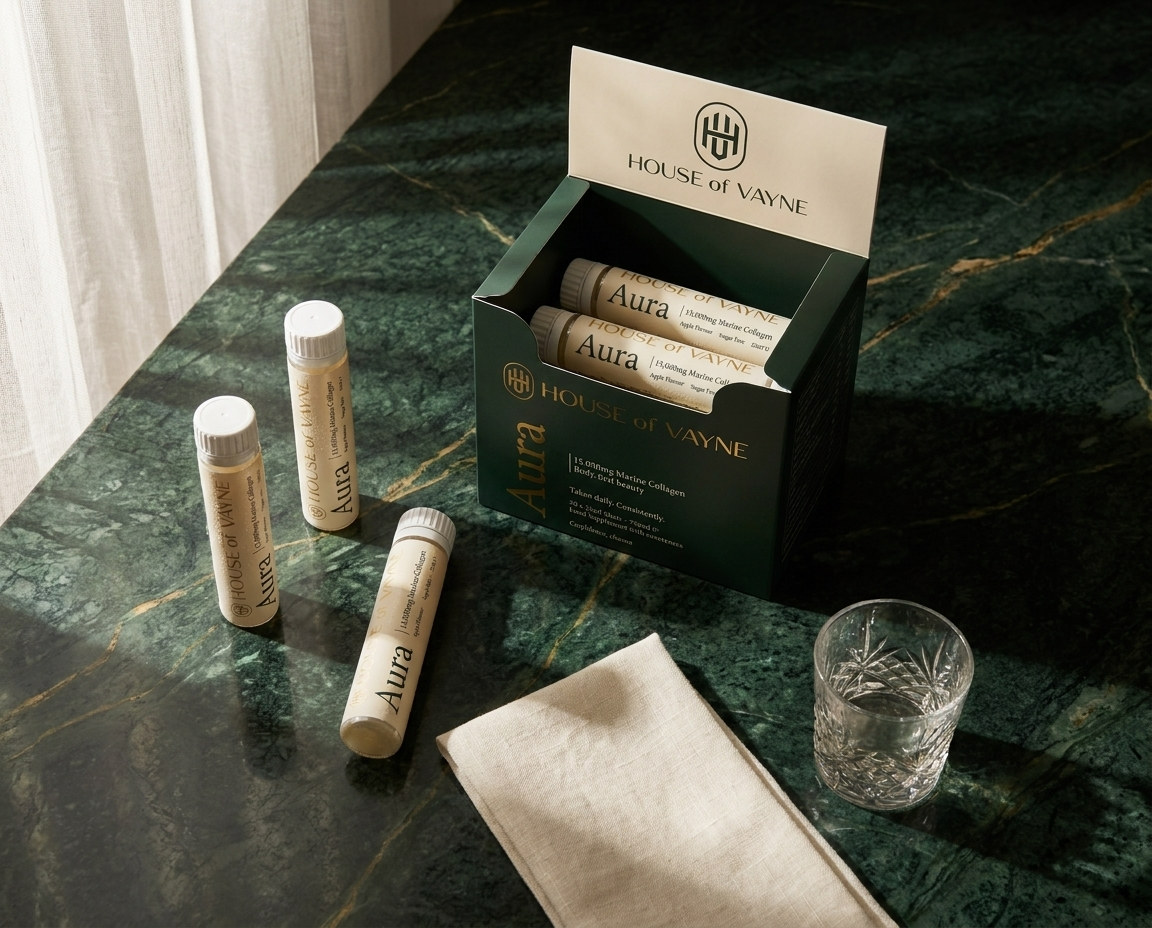
This is precisely why Aura includes Vitamin C alongside the 15,000mg marine collagen. The collagen peptides provide the amino acid building blocks, and the Vitamin C ensures your body can actually assemble these amino acids into stable, functional collagen molecules. Supplementing collagen without adequate Vitamin C is like giving a construction company bricks and mortar but no workers who know how to use them — the materials are there, but the synthesis cannot happen efficiently. The combined approach — high-dose collagen peptides plus Vitamin C co-factor — represents the evidence-aligned formula for supporting collagen synthesis.

People Also Ask

Does collagen work for joint health?

The evidence base shows collagen supplementation also supports joint health through similar mechanisms. Joints contain collagen in cartilage and connective tissue. Studies show improvements in joint comfort and mobility with collagen supplementation. The mechanisms are similar: amino acid provision for collagen synthesis, potentially enhanced by collagen peptide signalling.

How long does collagen take to affect hair and nails?

Nails and hair are faster-growing tissues than skin. Changes typically appear by week 4-6 because the nail matrix continuously produces new nail cells, and hair follicles are continuously producing new hair. Skin changes take longer (8-12 weeks) because dermal collagen turnover is slower. Hair and nails respond first, serving as early indicators of collagen status.

Can I get collagen from my diet instead of supplements?

Dietary collagen from bone broth, gelatin, or skin-on meat does provide collagen. However, the dose is typically much lower than supplements, and hydrolysed collagen in supplements achieves better absorption than collagen in food. Supplements provide concentrated, standardised doses; food provides variable amounts. For measurable skin improvements, supplementation is more reliable than dietary sources.

Why does collagen decline faster in women after menopause?

Oestrogen plays a regulatory role in collagen synthesis. Fibroblasts (collagen-producing cells) are more active when oestrogen is present. After menopause, oestrogen drops 90%, removing this growth signal. The decline accelerates from 1-1.5% annually to 2.1% annually. This is why post-menopausal women see rapid skin aging and why collagen supplementation becomes particularly important during this life stage.

Key Takeaway
Collagen is the structural protein making up 75-80% of skin dry weight. Production declines 1-1.5% annually from mid-twenties, accelerating post-menopause. Oral supplementation provides amino acids your fibroblasts use for new collagen synthesis. Clinical evidence confirms measurable improvements in elasticity and hydration. Vitamin C is essential for this process to work.
References
  1. Varani, J. et al. (2006). "Decreased Collagen Production in Chronologically Aged Skin." American Journal of Pathology, 168(6), 1861-1868. PMC1606623
  2. Shuster, S. et al. (1975). "The Etiology of Senile Angiomas." British Journal of Dermatology, 94(5), 499-507.
  3. Pu, S.Y. et al. (2023). "Effects of Oral Collagen for Skin Anti-Aging: A Systematic Review and Meta-Analysis." Nutrients, 15(9), 2080. PMC10180699
  4. Pullar, J.M. et al. (2017). "The Roles of Vitamin C in Skin Health." Nutrients, 6(8), 392. PMC5579659
  5. Bolke, L. et al. (2019). "A Collagen Supplement Improves Skin Hydration, Elasticity, Roughness, and Density." Nutrients, 11(10), 2494. PMC6835901

Leave a comment

This site is protected by hCaptcha and the hCaptcha Privacy Policy and Terms of Service apply.