

Marine Collagen in the UK: Dose, Format and Cost Compared
The Short Answer: What separates one marine collagen from another is dose per serving, source and type, format, the cofactors alongside it, and cost per gram. Across 72 UK collagen products surveyed in August 2026, the mean dose was 6,950mg a serving and the median around 5,500mg. The spread by format is enormous: powders averaged 11,285mg, liquid shots and sachets 8,675mg, capsules and tablets 1,547mg, gummies 708mg. Format tells you more about dose than the brand name does.
What should you compare when evaluating marine collagen?
Most collagen roundups rank products by brand recognition, packaging or editorial partnership. Those rankings tell you which brands have the largest marketing budgets. They do not tell you what is in the bottle. Five variables do: dose per serving, collagen source and type, delivery format, supporting ingredients, and cost per gram of actual collagen.
Dose is the one most often obscured. Published trials on skin outcomes have used doses running from a few hundred milligrams up to 10,000mg a day. The trial set is catalogued by Pu et al. (2023), and the highest dose in it, 10.0g, is stated in the primary paper by Nomoto and Iizaka (2020). Three further randomised controlled trials have used 15,000mg a day, in muscle and body-composition research rather than skin (Zdzieblik et al., 2015; Jendricke et al., 2019; Kirmse et al., 2019). Worth knowing, because plenty of marketing implies 15,000mg has never been studied at all. It has.
What has not been established is a dose-response relationship. No published trial compares one collagen dose against another for skin outcomes, so nobody can tell you that more is proportionally better. Anyone who does is extrapolating. What dose does tell you is what you are buying, and whether it sits anywhere near the amounts used in the research.
Source and type are worth checking because they are frequently vague. Marine collagen is predominantly Type I, and Type I is the most common collagen in skin (León-López et al., 2019). A label that says only "collagen" is not telling you enough to compare.
Supporting ingredients matter because collagen synthesis has cofactors. Vitamin C contributes to normal collagen formation for the normal function of skin. A formulation carrying it alongside the collagen has been designed rather than assembled.
How much collagen is in a typical UK serving?
We surveyed 72 UK collagen products across every format in August 2026, verifying each dose against a live product page rather than a marketplace listing. The averages, by format:
| Format | Products surveyed | Mean dose per serving |
| Powders | 26 | 11,285mg |
| Liquid shots and sachets | 20 | 8,675mg |
| Capsules and tablets | 18 | 1,547mg |
| Gummies | 8 | 708mg |
| All formats | 72 | 6,950mg |
Two things fall out of that table. The first is that format predicts dose far better than price or brand does. A gummy averages under a gram. A powder averages over eleven. If you are choosing between a capsule and a powder, you are mostly choosing between two different doses wearing the same word on the front of the pack.
The second is that powders, on average, carry more collagen per serving than liquids do. That is the opposite of what most liquid collagen marketing implies. The liquid advantage is not a higher ceiling. It is that the dose is fixed at the factory rather than by whoever is holding the scoop.
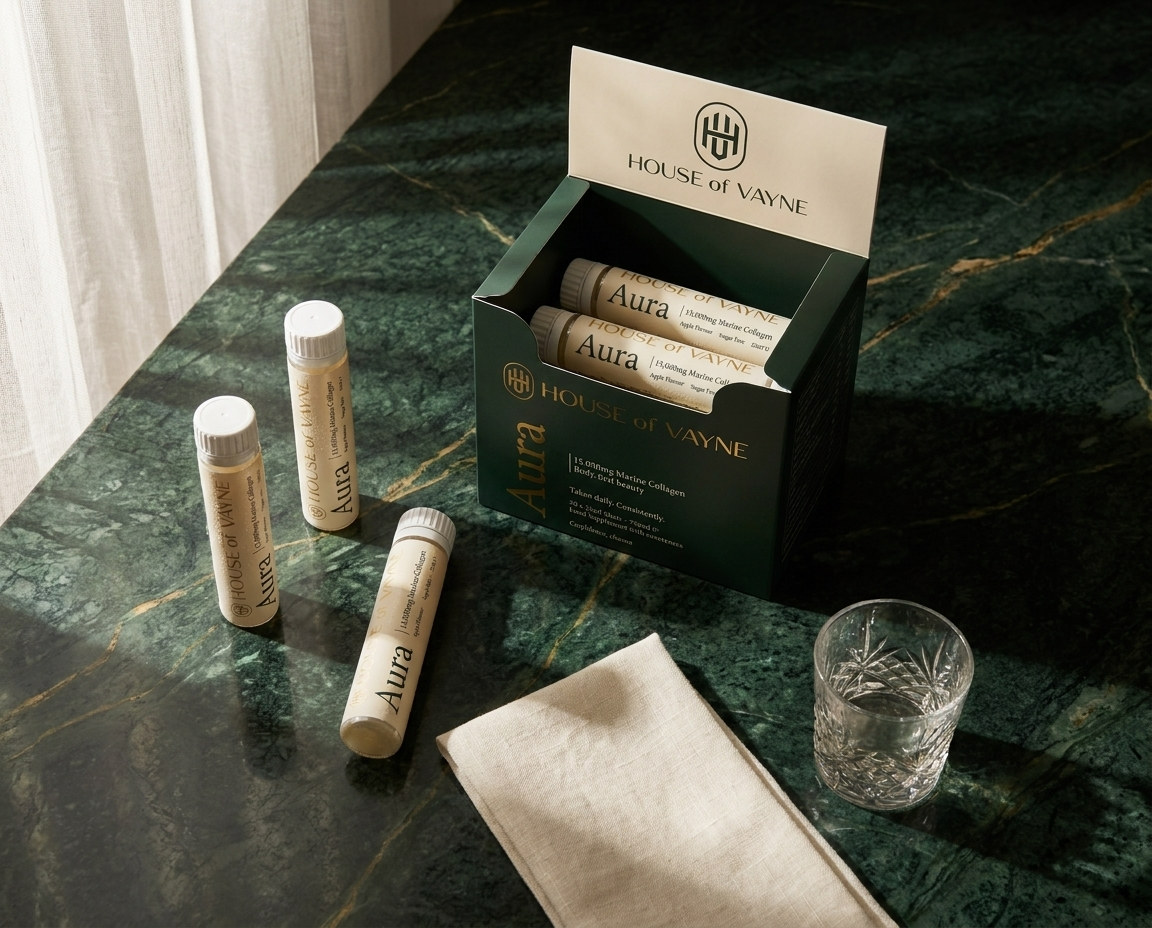
Aura delivers 15,000mg of hydrolysed marine collagen per 25ml shot, which is around twice the 6,950mg average across the survey.
How does cost per gram compare?
Sticker price misleads because it prices the box, not the collagen. Run the sum instead.
A £40 product at 5,000mg a serving for 30 days delivers 150g of collagen. That is £0.27 a gram. A £85 product at 15,000mg a serving for 30 days delivers 450g. That is £0.19 a gram. Three times the collagen for roughly twice the money, so the more expensive box is the cheaper one per gram.
It does not always land that way. A well-priced bulk powder can undercut almost anything on cost per gram. Capsules and gummies are where it turns brutal, because the dose falls by an order of magnitude while the price does not. Whether expensive collagen is worth it comes down to this sum, not to the number on the shelf edge.
What separates a well-formulated marine collagen from the rest?
Three things.
Dose transparency. The pack should state exactly how many milligrams of hydrolysed marine collagen peptides are in each serving. No proprietary blends, no totals padded with fillers, no collagen complex labels that obscure the actual content. A brand confident in its formulation has no reason to hide the number.
A dose that sits near the research. Published skin trials have run up to 10,000mg a day. A product charging a premium while delivering a tenth of that is charging for something other than collagen.
A complete formulation. Collagen peptides are the substrate. Aura is marine collagen plus 12 actives: vitamin A, vitamin C, vitamin B5, biotin, vitamin D3, vitamin K2, zinc, selenium, MSM, hyaluronic acid, elastin and astaxanthin. Vitamin C contributes to normal collagen formation for the normal function of skin. The rest are stated because they are in there, at the doses printed on the pack, and you are entitled to know what you are drinking.
People Also Ask
Which UK marine collagen has the highest dose?
It depends on the format, and anyone who answers this without saying so is selling you something. Several UK powders reach 20,000mg per serving. Among liquid shots, Aura's 15,000mg per 25ml is at the top end of the 20 liquid products in our survey, which averaged 8,675mg. Across all 72 products the average was 6,950mg, so 15,000mg is around twice the category average.
Is liquid marine collagen better than powder?
Not on dose. Powders averaged 11,285mg a serving in our survey against 8,675mg for liquids, so the format that most often carries the biggest number is powder. Liquid wins on precision and on friction: the dose is measured for you, fully dissolved, and takes five seconds. If you will genuinely weigh and mix a powder every night, powder is a perfectly good answer. Most people will not, which is the real argument for a shot.
Are expensive marine collagen brands just better marketing?
Some are. But price differences can also reflect genuine formulation differences: higher doses, marine sourcing, liquid manufacturing and meaningful cofactors. Calculate cost per gram to find out which you are looking at. If two products carry the same dose and one costs twice as much, the difference is marketing.
Key Takeaway: Judge marine collagen on dose per serving, source and type, format, cofactors and cost per gram. Across 72 UK products surveyed in August 2026 the average serving was 6,950mg, and format predicted dose better than brand did. Aura delivers 15,000mg of hydrolysed marine collagen per 25ml shot, plus 12 actives, at around twice the category average.
References
House of Vayne UK collagen dose survey, August 2026. 72 UK collagen supplement products across all formats, each dose verified against a live product page. Mean 6,950mg per serving, median approximately 5,500mg. Powders 11,285mg (26 products), liquid shots and sachets 8,675mg (20), capsules and tablets 1,547mg (18), gummies 708mg (8).
Pu, S.Y. et al. (2023). "Effects of Oral Collagen for Skin Anti-Aging: A Systematic Review and Meta-Analysis." Nutrients, 15(9), 2080. PMC10180699. Source for the catalogue of skin trials, their participant numbers and their durations.
León-López, A. et al. (2019). "Hydrolyzed Collagen: Sources and Applications." Molecules, 24(22), 4031. PMC6891674. Source for Type I being the most common collagen in skin.
Nomoto, T. & Iizaka, S. (2020). "Effect of an Oral Nutrition Supplement Containing Collagen Peptides on Stratum Corneum Hydration and Skin Elasticity in Hospitalized Older Adults." Advances in Skin & Wound Care, 33(4), 186-191. PMID 32195722. Source for the highest daily collagen dose used in published skin research, stated in the paper as 10.0g.
Zdzieblik, D. et al. (2015). "Collagen peptide supplementation in combination with resistance training improves body composition and increases muscle strength in elderly sarcopenic men: a randomised controlled trial." British Journal of Nutrition, 114(8), 1237-1245. PMID 26353786. Funded in part by Gelita AG.
Jendricke, P. et al. (2019). "Specific Collagen Peptides in Combination with Resistance Training Improve Body Composition and Regional Muscle Strength in Premenopausal Women: A Randomized Controlled Trial." Nutrients, 11(4), 892. PMID 31010031. Funded in part by GELITA GmbH.
Kirmse, M. et al. (2019). "Prolonged Collagen Peptide Supplementation and Resistance Exercise Training Affects Body Composition in Recreationally Active Men." Nutrients, 11(5), 1154. PMID 31126103. Funded by the Collagen Research Institute.
Related reading


Leave a comment
This site is protected by hCaptcha and the hCaptcha Privacy Policy and Terms of Service apply.