

Is Expensive Collagen Worth It?
The Short Answer: Sticker price tells you very little. The number that tells you something is cost per gram of hydrolysed collagen. A £25 powder at 5,000mg a serving works out at £0.17 a gram. Aura, at £85 for thirty 15,000mg shots, works out at £0.19 a gram, and £0.15 a gram on subscription. Three times the shelf price, and near enough the same cost per gram. Expensive is worth paying when the money went into the formulation rather than around it.
Why does the price of collagen supplements vary so much?
Walk into any pharmacy or browse any supplement retailer and you will find collagen products ranging from £10 to £100 a month. That ten-fold spread cannot be explained by a single variable. It reflects collagen dose, collagen source, delivery format, supporting ingredients, manufacturing standards, and, critically, the ratio of formulation investment to marketing investment.
Marine collagen costs more than bovine as a raw material. Higher doses need more raw material per serving. Liquid formats need different manufacturing, packaging and distribution from powders or tablets. These are legitimate cost drivers. A product delivering 15,000mg of hydrolysed marine collagen in liquid form genuinely costs more to make than one delivering 3,000mg of bovine collagen in a tablet.
But raw material and manufacturing explain only part of the variation. The rest is brand positioning, influencer partnerships, celebrity endorsements, advertising spend and margin. Some premium-priced products command their price through marketing rather than formulation. You pay for the brand image, not the dose. The question is never whether a product is expensive. It is whether the expense went inside the bottle or around it.
How do you calculate the real cost of a collagen supplement?
The single most useful metric is cost per gram of hydrolysed collagen. It strips away packaging, marketing and positioning, and shows what you are paying for the active ingredient.
The calculation is simple. Take the price, divide by the total grams of collagen in the pack.
A £25 tub of powder holding 30 servings at 5,000mg (5g) a serving delivers 150g of collagen. £25 divided by 150 is £0.17 a gram.
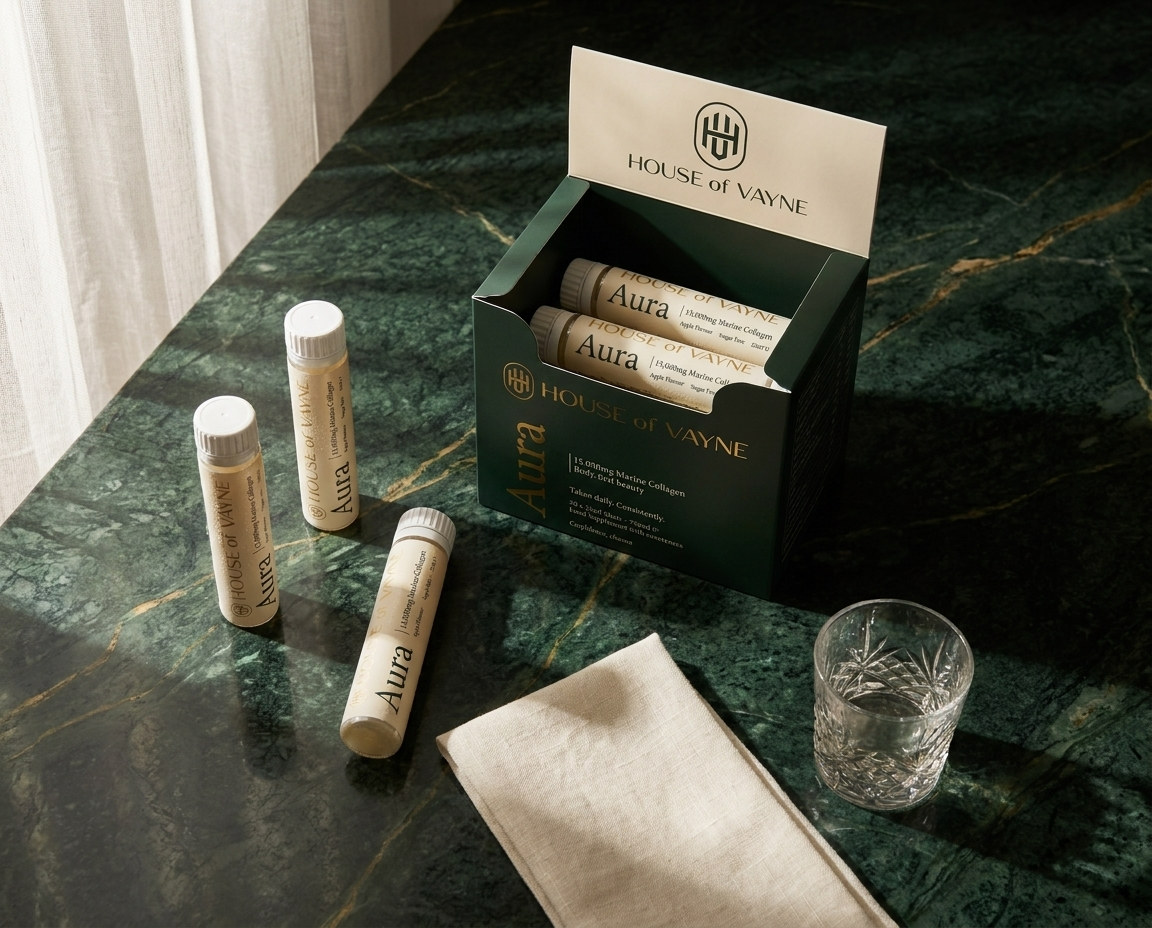
A £85 box of Aura holding 30 shots at 15,000mg (15g) a shot delivers 450g of collagen. £85 divided by 450 is £0.19 a gram. On subscription at £68, it is £0.15 a gram.
Look at what that actually says. The shelf prices differ by more than three times. The cost per gram differs by two pence, and at one-time purchase the powder is the marginally cheaper of the two. The arithmetic is the whole point of the exercise: it tells you something the shelf price cannot, and sometimes what it tells you is that the cheap thing was fairly priced all along.
Where the calculation turns decisively is at the other end of the market. A capsule or a gummy carries a fraction of the collagen a powder or a shot does, but not a fraction of the price. Run the same sum on those and the cost per gram is not close. We apply the same lens across the market in our guide to marine collagen in the UK.
What do you actually get from a premium formulation?
Four things that cheaper alternatives often skip: a dose that matches the published research, a format that can carry it, the cofactors collagen synthesis depends on, and a label that tells you the truth.
Dose that matches the research. Published trials on skin outcomes have used doses from a few hundred milligrams up to 10,000mg a day. The trial set is catalogued by Pu et al. (2023), and the highest dose in it, 10.0g, is stated in the primary paper by Nomoto and Iizaka (2020). Three further trials have used 15,000mg a day, in muscle and body-composition research rather than skin. Most budget products sit far below any of that. Aura delivers 15,000mg per shot, around twice the average dose across 72 UK collagen products surveyed in August 2026.
A format that can carry the dose. A capsule physically holds 500 to 1,000mg, so reaching a research-level dose means swallowing eight or ten of them. A liquid shot carries the dose in one 25ml serving, pre-measured, with nothing to weigh out and nothing left in the bottom of the glass.
The cofactors. Vitamin C contributes to normal collagen formation for the normal function of skin. Aura is marine collagen plus 12 actives: vitamin A, vitamin C, vitamin B5, biotin, vitamin D3, vitamin K2, zinc, selenium, MSM, hyaluronic acid, elastin and astaxanthin. A formulation that carries them is telling you something about how it was designed.
A label that tells you the truth. Transparent labelling means the pack states exactly how many milligrams of hydrolysed collagen peptides are in each serving. No proprietary blends, no vague collagen complexes, no total weights padded with fillers and flavourings. If a product hides its collagen content behind a blend name, assume there is a reason.
When is cheap collagen a false economy?
When the dose sits below almost every dose used in the published research, and you paid a full price for it anyway. If you take 2,000mg a day for three months, you have spent three months and the full price of those boxes on a serving size that sits below almost every dose in the published literature. The cheapest supplement in the shop is not cheap if the number on the back of it is decorative.
Per-night, the price looks different. Aura at £85 for a 30-night box is £2.83 a night. On subscription at £68, it is £2.27 a night. Monthly prices feel large and daily prices feel small, and the honest way to compare two habits is to price them the same way.
People Also Ask
Is there a point where paying more is just paying for the brand?
Yes, and often. The question is whether the premium went into formulation, meaning dose, format and ingredients, or into marketing, meaning influencer campaigns, endorsements and packaging design. Calculate cost per gram. If a premium-priced product delivers the same dose as a budget one, you are paying for the marketing. If it delivers considerably more, you are paying for the formulation.
Can a cheaper collagen supplement be worth buying?
If the dose is meaningful, yes. Plenty of the doses used in published research sit well below 15,000mg, and a cheaper product delivering 5,000mg or more of genuine hydrolysed collagen is a serious product. The threshold that matters is dose, not price. A £15 product at 5,000mg is a better buy than a £40 product at 1,000mg, and the cost-per-gram sum will tell you so in about ten seconds.
Why is marine collagen more expensive than bovine?
Raw material cost. Fish skin sourcing, the hydrolysis process and the processing needed to reach a low molecular weight all cost more per kilogram than the bovine equivalent. León-López et al. (2019) report hydrolysed fish collagen at molecular weights of around 3 to 5 kDa, inside a general hydrolysed collagen range of 3 to 6 kDa. Marine collagen is predominantly Type I, and Type I is the most common collagen in skin. The higher price reflects genuine manufacturing differences rather than arbitrary positioning.
Key Takeaway: Price is not the metric. Cost per gram of hydrolysed collagen is. Aura is £0.19 a gram at £85, and £0.15 a gram on subscription at £68, which is £2.27 a night for 15,000mg of hydrolysed marine collagen plus 12 actives in a 25ml shot. Run the same sum on whatever you are comparing it to. If a brand makes that difficult, that is information too.
References
Pu, S.Y. et al. (2023). "Effects of Oral Collagen for Skin Anti-Aging: A Systematic Review and Meta-Analysis." Nutrients, 15(9), 2080. PMC10180699. Source for the range of doses used across 26 randomised controlled trials.
León-López, A. et al. (2019). "Hydrolyzed Collagen: Sources and Applications." Molecules, 24(22), 4031. PMC6891674. Source for hydrolysed fish collagen molecular weight ranges and for Type I being the most common collagen in skin.
Nomoto, T. & Iizaka, S. (2020). "Effect of an Oral Nutrition Supplement Containing Collagen Peptides on Stratum Corneum Hydration and Skin Elasticity in Hospitalized Older Adults." Advances in Skin & Wound Care, 33(4), 186-191. PMID 32195722. Source for the highest daily collagen dose used in published skin research, stated in the paper as 10.0g.
House of Vayne UK collagen dose survey, August 2026. 72 UK collagen products across all formats, each verified against a live product page. Mean dose 6,950mg per serving, median approximately 5,500mg.
Related reading


Leave a comment
This site is protected by hCaptcha and the hCaptcha Privacy Policy and Terms of Service apply.