

How to Read a Collagen Supplement Label
The Short Answer: The single most important number on a collagen label is the milligram content of hydrolysed collagen peptides per serving. Not the blend weight. Not the collagen complex total. The actual hydrolysed collagen. Beyond that, check the source, check whether every ingredient is individually quantified, and check whether the claims printed on the pack are attached to nutrients that are actually in there at a dose that counts. That last check catches more brands than the other three put together.
What is the most important number on the label?
The milligram content of hydrolysed collagen peptides per serving. It is the one figure on the pack that is comparable between products, and it is the one most often left off.
Be clear about what that number does and does not tell you. No threshold has been established in the research, so nobody can tell you that a given number is enough. What a stated dose does tell you is what you are actually buying, which is more than most of the category is willing to put in writing. When comparing brands, this is the figure to line up, as we do in our comparison of marine collagen sold in the UK.
Look specifically for terms like hydrolysed collagen peptides, collagen hydrolysate, or hydrolysed marine collagen, followed by a milligram figure. Those terms describe collagen that has been enzymatically broken into low molecular weight peptides, which are absorbed into the bloodstream after oral intake. The hydrolysis step is what the words are recording, and the label should say so explicitly.
A product stating 10,000mg marine collagen complex is not the same as one stating 10,000mg hydrolysed marine collagen peptides. Complex can absorb fillers, flavourings, other proteins and non-collagen ingredients into the headline weight. Peptides and hydrolysate refer to the collagen fraction itself. That distinction is the difference between knowing what you are taking and being led by a large number.
Read more: 15,000mg Marine Collagen: Does Dose Actually Matter?
What is a proprietary blend, and why be cautious?
A proprietary blend lists ingredients without disclosing individual quantities. The label might read: Collagen Beauty Blend 5,000mg, containing hydrolysed collagen, hyaluronic acid, vitamin C and biotin. You know the blend weighs 5,000mg. You do not know whether that is 4,800mg of collagen and 200mg of everything else, or 2,000mg of collagen and 3,000mg of cheaper material. This is common, and it is legal. It just leaves you making the decision without the information you would need to evaluate it.
The commercial reason is straightforward. Blends let a manufacturer use less of the expensive ingredient while marketing the total. A consumer reads 5,000mg and assumes it is collagen. Often it is not. Legal, and not transparent.
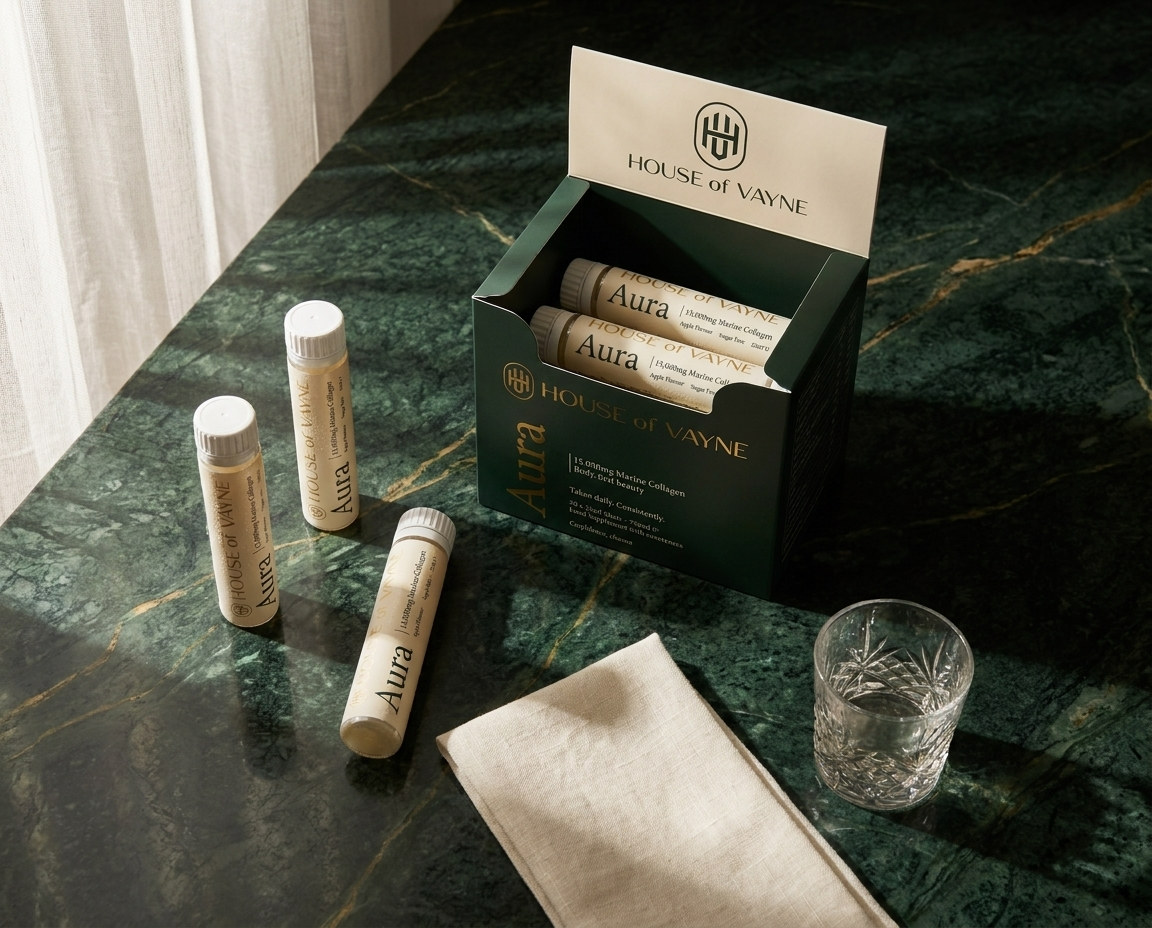
Products that disclose every ingredient quantity are inviting scrutiny rather than avoiding it. Aura lists each one with its dose: 15,000mg hydrolysed marine collagen, 120mg vitamin C, 50mg hyaluronic acid, and every other component individually quantified, printed on the box. That is the standard that makes an informed decision possible. Where a product does not meet it, the question worth asking is why.
Read more: Why Most Collagen Supplements Are Underdosed, And How to Tell
How do you read the collagen source?
The label should specify marine (fish), bovine (cattle), porcine (pig) or chicken. Marine collagen is predominantly Type I. Type I is the main collagen found in skin, representing 80 to 90 per cent of skin collagen (Reilly and Lozano, 2021). Bovine sources carry Type I and Type III. Those are statements about what the material is, and identity is worth knowing on its own terms. They are not statements about what any of it will do for you, and a label that slides from one to the other is hoping you will not notice the join.
Molecular weight is occasionally listed on more expensive products. Hydrolysed collagen peptides generally sit in a low molecular weight range, around 3,000 to 6,000 Da (Leon-Lopez et al., 2019). Treat that as a specification rather than a selling point. No published human study has compared collagen absorption across delivery formats in either direction, so any brand claiming its liquid, powder or tablet absorbs better than the alternatives has nothing behind it. Where a controlled comparison of formats does exist, it is on vitamin C rather than collagen, and it did not favour the liquid: a vitamin C solution and a fast-disintegrating tablet showed significantly lower bioavailability than tablets that disintegrated more slowly (Bhagavan and Wolkoff, 1993). Format is worth choosing on behaviour instead, which we compare in liquid collagen vs powder vs tablets.
Read more: Marine Collagen vs Bovine Collagen: What the Research Actually Says
How to tell whether a claim on the pack is worth anything
This is the check almost nobody makes, and it is the most revealing one on the shelf.
Two things make a line on a pack worth reading. It has to be attached to a specific named nutrient, and that nutrient has to be present in a quantity that counts. The figure to measure against is 15% of the Nutrient Reference Value in the recommended daily portion. Below that, a nutrient is on the pack for the ingredient list and nothing more, however prominently it is printed on the front.
Two consequences follow, and both are easy to spot once you know them.
A line belongs to the nutrient that carries it, never to the product as a whole, and never to an ingredient with nothing behind it. Collagen has nothing behind it. Neither does hyaluronic acid, MSM, elastin or astaxanthin. So a pack telling you its collagen supports skin structure, or its hyaluronic acid hydrates and plumps, or its elastin restores elasticity, has written those sentences itself. There is nothing underneath them you could go and check. This is not a technicality. It is the single most common thing wrong with a collagen pack, and once you have seen it you will see it everywhere.
And the lines that do hold up are narrower than the shorthand suggests. Biotin belongs with skin and hair, not with nails. Selenium belongs with hair and nails, not with skin. So the phrase this category prints on almost every pack, biotin, zinc and selenium for skin, hair and nails, puts two of them in the wrong place. Correctly split: biotin contributes to the maintenance of normal skin, and to the maintenance of normal hair. Zinc contributes to the maintenance of normal skin, to the maintenance of normal hair, and to the maintenance of normal nails. Selenium contributes to the maintenance of normal hair, and to the maintenance of normal nails. Vitamin A contributes to the maintenance of normal skin, which most collagen brands leave off the pack entirely.
What supporting ingredients should you look for?
Vitamin C first. Vitamin C contributes to normal collagen formation for the normal function of skin. Note what that line is about: the collagen your own body forms. It is not about the collagen in the bottle, and it should never be presented as though it were. Check the dose against the reference value. The GB Nutrient Reference Value for vitamin C is 80mg, so 15% of it is 12mg, and a product carrying less than that is not carrying a meaningful amount of it. Aura contains 120mg, which is 150% of the reference value.
Hyaluronic acid is a different case. What a brand can honestly tell you is that it is present, and at what dose. Anything about hydration, plumpness or joints has nothing underneath it, however familiar it sounds. Aura contains 50mg, and the dose is the fact.
Vitamin D is worth a second look when you see it on a beauty supplement, because it does not belong with skin. Where it does belong: vitamin D contributes to the normal function of the immune system and to the maintenance of normal bones. Zinc, selenium and vitamin C each contribute to the protection of cells from oxidative stress, which is where an antioxidant line properly sits. Astaxanthin, which is where most brands point when they say antioxidant, is not one of them.
Read more: What Is in Aura? Every Ingredient Explained
What should make you put a product back on the shelf?
No milligram figure for the collagen itself. If a label will not tell you how much hydrolysed collagen is in a serving, there is usually a reason, and it is rarely a flattering one.
A skin, hair or nail claim attached to the collagen itself. Nothing supports that sentence at any dose, so it tells you the brand either has not checked or is hoping you have not.
Unhydrolysed or native collagen as the primary ingredient, with no mention of hydrolysis anywhere on the pack. Hydrolysis is what produces the low molecular weight peptides that are absorbed after oral intake, and a label silent on it is silent about the thing that matters most in the processing.
Heavy added sugar. Some gummies and flavoured drinks carry several grams per serving, which is sugar you did not set out to buy, on top of a dose that is usually small to begin with.
Vague sourcing. Collagen with no stated animal source prevents you from knowing what type you are getting. Any manufacturer willing to print it does print it.
People Also Ask
Does the order of ingredients matter?
Yes. UK labelling rules require ingredients to be listed in descending order of weight. In a product that is primarily a collagen supplement, hydrolysed collagen should be at or near the front. If it appears third or fourth, then water, sweeteners or fillers make up more of the product than the collagen does.
What does Type I and III collagen mean?
It usually indicates a bovine source, which naturally contains both. Type I is the main collagen found in skin, at 80 to 90 per cent of skin collagen. Type III is more prevalent in connective tissue. Marine sources are predominantly Type I. That is a description of the material, not a ranking of products.
Should I look for third-party testing?
It is a reasonable signal. Certifications such as NSF, Informed Sport or ISO accreditation mean an independent laboratory has verified that the contents match the label. That is assurance about accuracy rather than about effect, and accuracy is the thing most worth verifying when a brand is claiming a high dose.
What is the difference between collagen and collagen peptides?
Collagen peptides means hydrolysed collagen, broken into small fragments, generally around 3,000 to 6,000 Da. Collagen alone may mean unhydrolysed collagen protein, whose molecules are considerably larger. Look for peptides, hydrolysed or hydrolysate to confirm which one you are holding.
Key Takeaway: A label tells you what you are buying, and almost nothing else. Look for hydrolysed collagen peptides with a specific milligram figure, a stated source, vitamin C at a dose that clears 15% of the reference value, and every ingredient individually quantified. Then check every line on the pack against the nutrient it is attached to, and the dose of that nutrient. If the collagen content is hidden inside a proprietary blend, or the pack hangs a skin claim on the collagen itself, the product was not built for someone who reads labels.
References
Nutrient Reference Values, retained Regulation (EU) No 1169/2011, Annex XIII.
GB Nutrition and Health Claims Register. Authorised claim wording quoted as published.
Leon-Lopez, A. et al. (2019). "Hydrolyzed Collagen: Sources and Applications." Molecules, 24(22), 4031. PMC6891674
Reilly, D.M. and Lozano, J. (2021). "Skin Collagen Through the Lifestages: Importance for Skin Health and Beauty." Plastic and Aesthetic Research, 8, 2. DOI: 10.20517/2347-9264.2020.153. Both authors work for Minerva Research labs, which produces collagen-based supplements.
Bhagavan, H.N. and Wolkoff, B.I. (1993). "Correlation between the disintegration time and the bioavailability of vitamin C tablets." Pharmaceutical Research, 10(2), 239-242. PMID 8456071


Leave a comment
This site is protected by hCaptcha and the hCaptcha Privacy Policy and Terms of Service apply.