
Do Collagen Supplements Actually Work?
The Short Answer: The trials on oral collagen are real, and almost every individual one of them was paid for by a collagen manufacturer. What matters is what the research actually contains: how many people were in it, how long it ran, who funded it, and what you can check on a label before you spend anything.
What does the published research actually show?
Two systematic reviews sit at the top of the evidence. Pu et al. (2023) pooled 26 randomised controlled trials covering 1,721 participants. Dewi et al. (2023) pooled 14 trials covering 967 participants. Both reported statistically significant differences in instrument-measured skin hydration and elasticity between collagen groups and placebo groups. Both are the strongest form of evidence the category has.
Two things about them are usually left out.
The first is the dose range. In Pu's own table the trials run from 372mg a day at the low end up to a printed 12g at the high end. There is no 12g collagen trial, despite that figure being widely repeated. It comes from a transcription error, and Pu's table is where it sits. The trial carrying that entry, Nomoto and Iizaka (2020), gave 10.0g of collagen peptides inside a product containing 12.0g of total protein, and the total protein figure was carried forward as though it were the dose. The primary paper is explicit: daily collagen peptide intake was 10.0g. The highest actual collagen dose in the table is 10g.
The second is funding. The two reviews themselves are clean. Pu et al. was funded by an institutional grant at Taipei Medical University, and Dewi et al. declared no competing interests. But a review only pools the trials underneath it, and every individual trial in this field, at every dose, is manufacturer-funded or manufacturer-supported. The most quoted number in the whole category is a 22.7% rise in a skin elasticity index at 8,000mg a day over 12 weeks. It comes from a single trial, Reilly et al. (2024), funded by the collagen brand Absolute Collagen, with every author but one employed by the company. That does not make it dishonest. It does mean it is one industry trial rather than a body of independent work, and it should never be quoted as though it were the latter.
It is worth being equally clear about what the research does not show. No trial has compared one collagen dose against another for skin outcomes. Not one. The doses sit in separate studies, with different participants, different products, different measuring equipment and different funders, which means they cannot be ranked against each other. Anyone describing a dose-response relationship for collagen and skin is reading a pattern into data that was never built to produce one.
How good is that evidence, really?
Good enough to be worth reading. Not good enough to promise you anything.
The individual trials in this field are small. When the ASA examined the studies a UK collagen brand had submitted to support its advertising, the trial arms held 20 participants each, and the supporting consumer study 52 (ASA ruling A23-1196136, 22 November 2023). The participants are frequently not representative of the people the advertising is aimed at. And the thing measured in the study is often not the thing the marketing talks about: in that same ruling, a study measuring moderate wrinkles was held not to substantiate a claim about fine lines.
That gap is worth knowing about, because it is where a great deal of this category lives. Holding a study and being able to stand behind what you say about it are two different things, and the difference sits in the detail nobody prints on the front of a box: how many people, who they were, what was actually measured, over how long, and who paid for it.
Why are people still sceptical about collagen?
First, the supplement industry earned it. Decades of proprietary blends hiding small doses, celebrity endorsement standing in for evidence, and claims made because they sold rather than because they were substantiated. Collagen arrived into that reputation and inherited it.
Second, a great deal of the category is thinly dosed, and the average hides how thinly. A survey of 72 UK collagen products in August 2026 found a mean of 6,950mg per serving and a median of about 5,500mg. That mean is carried almost entirely by powders, which averaged 11,285mg. Capsules and tablets averaged 1,547mg. Gummies averaged 708mg. Someone comparing a collagen gummy with a collagen powder is not comparing two versions of the same product.
Third, brands promise timelines. Two weeks, four weeks, eight weeks, twelve weeks. Those numbers are lifted from how long the trials ran, not from any finding about when a particular person will notice anything, and no brand is in a position to promise a result by a date. When the date passes and nothing has happened, the customer concludes the whole category is dishonest. The promise created that, not the product.
What can you actually check before you buy?
Dose, stated properly. Look for a milligram figure attached to the words hydrolysed collagen peptides, collagen hydrolysate, or hydrolysed marine collagen. A total for a blend or a complex is a different number, and it is usually a great deal larger than the collagen inside it.
Source and type. Marine collagen is extracted from fish skin and scale. Type I is the main collagen in skin, at 80 to 90 per cent of skin collagen (Reilly and Lozano, 2021). Bovine sources carry Type I and Type III. That is a statement about what the material is, not a statement about what it will do for you.
Form. Hydrolysis breaks collagen into low molecular weight peptides, which are absorbed into the bloodstream after oral intake. No published human study compares collagen absorption across delivery formats in either direction, so a brand claiming its liquid, powder or tablet absorbs better than the others has no evidence for it.
Whether what is printed is attached to the right thing. On any supplement label, a stated benefit belongs to a named nutrient at a stated dose, and the nutrient has to be present in enough of it to count. If a pack hangs a skin line on the collagen itself, or on the hyaluronic acid, or on the elastin, ask which nutrient is carrying it and how much of that nutrient is in there. If nothing on the label answers that, the pack was written for someone who was not going to check.
What is actually in Aura?
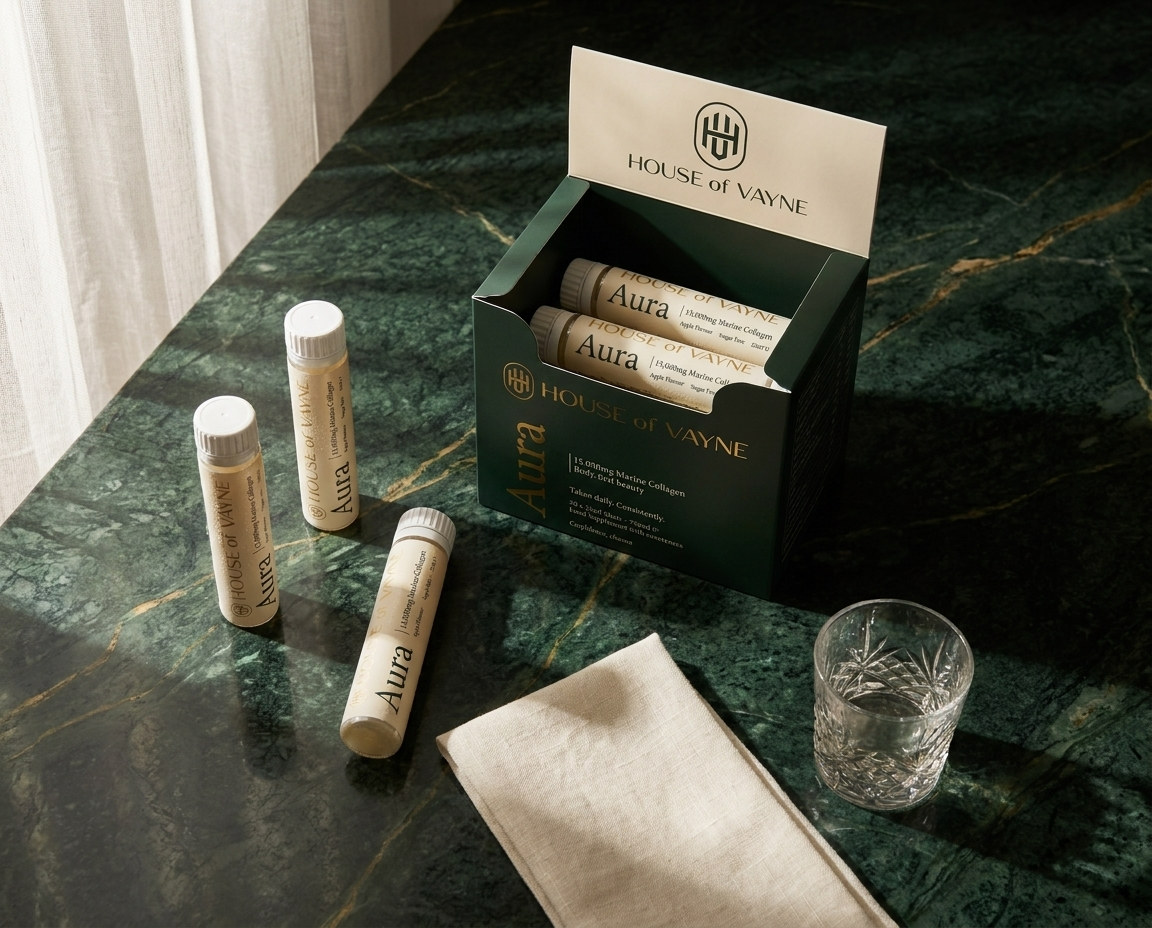
Aura is a 25ml shot containing 15,000mg of hydrolysed marine collagen, Types I and III, plus 12 actives. Every dose is printed on the box.
On dose, two facts, both narrow. The highest dose used in published skin research is 10,000mg a day, so 15,000mg is more than any dose used in published skin research. It is not more than any dose used in collagen research overall: three randomised controlled trials have used exactly 15g a day (Zdzieblik et al., 2015; Jendricke et al., 2019; Zdzieblik et al., 2021), though all three measured muscle and body composition rather than skin. Against the market, 15,000mg is around twice the average dose across the 72 UK collagen products surveyed in August 2026.
On the 12 actives, five relate to skin, hair or nails. Vitamin C contributes to normal collagen formation for the normal function of skin. Vitamin A contributes to the maintenance of normal skin. Biotin contributes to the maintenance of normal skin, and to the maintenance of normal hair. Zinc contributes to the maintenance of normal skin, to the maintenance of normal hair, and to the maintenance of normal nails. Selenium contributes to the maintenance of normal hair, and to the maintenance of normal nails.
Two notes on that list, because the category gets both wrong routinely. Biotin belongs with hair and skin, not with nails. Selenium belongs with hair and nails, not with skin. So the sentence printed on pack after pack, biotin and selenium for skin, hair and nails, puts two of them in the wrong place. And the vitamin C line concerns the collagen your own body forms. It is not about the marine collagen in the shot, and it should never be presented as though it were.
The collagen, the hyaluronic acid, the MSM, the elastin and the astaxanthin are in the shot at these doses. Marine collagen, 15,000mg. Hyaluronic acid, 50mg. MSM, 200mg. Elastin, 10mg. Astaxanthin, 2mg.
People Also Ask
Are collagen supplements just a placebo?
The trials are blinded and placebo-controlled, and the collagen groups did separate from the placebo groups on instrument-measured hydration and elasticity across the 26 trials pooled by Pu et al. (2023) and the 14 pooled by Dewi et al. (2023). So the measured difference is not nothing. The caveats stand: the individual trials are manufacturer-funded, and a difference measured across a trial population is an average, not a forecast for any one person in it.
Why did collagen not work for me?
What can be compared between products is measurable: the milligram content of actual hydrolysed collagen peptides, whether it was taken daily or occasionally, and for how long. The trials in this field ran for 8 to 12 weeks, which tells you how long researchers ran them. It does not tell you how long you should expect to wait, and nobody is in a position to tell you that.
Do dermatologists recommend collagen supplements?
Views differ. An endorsement is not evidence. If a recommendation carries weight with you, ask what sits underneath it: how many people were studied, over how long, and who paid for the work.
Is collagen safe to take every day?
What is on record is that the published trials ran daily doses of 372mg to 10,000mg against skin endpoints, and 15g a day in three body composition trials, over 8 to 12 weeks, without reporting adverse effects at those doses over those periods. That is a description of what the trials found, not an assurance about you. Aura contains fish. If you are pregnant, breastfeeding, taking medication, or have an allergy, speak to a doctor or pharmacist before starting any supplement.
Key Takeaway: The evidence for oral collagen is real, measured, and almost entirely paid for by collagen manufacturers. So the useful questions are not about promises. They are about dose stated in milligrams, source, form, and whether what is printed on the label is attached to the nutrient that carries it. Aura is 15,000mg of hydrolysed marine collagen with 12 actives, every dose printed on the box.
References
Pu, S.Y. et al. (2023). "Effects of Oral Collagen for Skin Anti-Aging: A Systematic Review and Meta-Analysis." Nutrients, 15(9), 2080. PMC10180699. Funded by an institutional grant, Taipei Medical University.
Dewi, D. A. R. et al. (2023). "Exploring the Impact of Hydrolyzed Collagen Oral Supplementation on Skin Rejuvenation: A Systematic Review and Meta-Analysis." Cureus, 15(12), e50231. PMC10773595. No competing interests declared.
Reilly, D. M. et al. (2024). "A Clinical Trial Shows Improvement in Skin Collagen, Hydration, Elasticity, Wrinkles, Scalp, and Hair Condition following 12-Week Oral Intake of a Supplement Containing Hydrolysed Collagen." Dermatology Research and Practice, 2024, 8752787. PMC11254459. Funded by Absolute Collagen; all authors but one are Absolute Collagen employees.
Nomoto, T. and Iizaka, S. (2020). "Effect of an Oral Nutrition Supplement Containing Collagen Peptides on Stratum Corneum Hydration and Skin Elasticity in Hospitalized Older Adults." Advances in Skin and Wound Care, 33(4), 186-191. PMC7328867. Test products and equipment supplied by Nutri Co Ltd.
Zdzieblik, D. et al. (2015). "Collagen peptide supplementation in combination with resistance training improves body composition and increases muscle strength in elderly sarcopenic men: a randomised controlled trial." British Journal of Nutrition, 114(8), 1237-1245. PMC4594048. Part-funded by Gelita AG.
Jendricke, P. et al. (2019). "Specific Collagen Peptides in Combination with Resistance Training Improve Body Composition and Regional Muscle Strength in Premenopausal Women: A Randomized Controlled Trial." Nutrients, 11(4), 892. PMC6521629. Part-funded by GELITA.
Zdzieblik, D. et al. (2021). "The Influence of Specific Bioactive Collagen Peptides on Body Composition and Muscle Strength in Middle-Aged, Untrained Men: A Randomized Controlled Trial." International Journal of Environmental Research and Public Health, 18(9), 4837. PMC8125453. Part-funded by GELITA.
Advertising Standards Authority (2023). Ruling A23-1196136.
Reilly, D.M. and Lozano, J. (2021). "Skin Collagen Through the Lifestages: Importance for Skin Health and Beauty." Plastic and Aesthetic Research, 8, 2. DOI: 10.20517/2347-9264.2020.153. Both authors work for Minerva Research Labs, which produces collagen-based supplements.
Leon-Lopez, A. et al. (2019). "Hydrolyzed Collagen: Sources and Applications." Molecules, 24(22), 4031. PMC6891674
House of Vayne UK collagen dose survey, August 2026. 72 UK collagen products, each dose verified against a live product page.
Related reading


Leave a comment
This site is protected by hCaptcha and the hCaptcha Privacy Policy and Terms of Service apply.