

What Happens When You Stop Taking Collagen
The Short Answer: When you stop taking collagen, your body returns to its baseline rate of collagen production, which declines approximately 1 to 1.5% per year from your mid-twenties (Reilly & Lozano, 2021). The improvements you achieved are not immediately lost, but without continued supplementation, the elevated amino acid availability that supported enhanced collagen synthesis is no longer present. Over weeks to months, your skin gradually reverts toward pre-supplementation status. Results are maintained by maintenance, not by a one-off course.
Why are collagen results not permanent?
Collagen supplementation works by providing your fibroblasts with an elevated supply of amino acids, particularly glycine, proline, and hydroxyproline, that serve as building blocks for new collagen synthesis. When you supplement daily, you maintain a sustained elevated level of these amino acids in your bloodstream. Your fibroblasts have abundant raw materials and can produce collagen at a rate that exceeds their baseline capacity. This is what produces the measurable improvements in skin elasticity and hydration documented in clinical trials.
When you stop supplementing, that elevated amino acid supply disappears. Your body returns to relying on dietary protein alone for collagen synthesis. Unless your diet is exceptionally rich in collagen-specific amino acids (which most modern diets are not), your fibroblasts lose access to the concentrated substrate they had been utilising. Their collagen production rate returns to baseline, the same rate that was producing a net deficit before you started supplementing. The underlying decline of 1 to 1.5% per year continues regardless.
This is analogous to any maintenance-based approach. Exercise builds muscle, but if you stop exercising, muscle gradually atrophies back toward baseline. Retinoid use stimulates epidermal turnover, but if you stop using retinoids, your skin reverts to its previous turnover rate. Collagen supplementation maintains an elevated production state. It does not permanently alter your body's collagen biology. The benefits persist for as long as the input persists.
Read more: What Collagen Actually Does for Your Skin, Hair and Nails
How quickly do results fade after stopping?
The timeline for regression is not precisely documented in the published literature because most clinical trials measure improvement during supplementation rather than decline after cessation. However, the biology provides reasonable expectations. Dermal collagen turnover is slow, the full remodelling cycle takes months, not days. This means that improvements do not vanish overnight. The collagen your body synthesised while you were supplementing remains in place and degrades at the normal rate.
The most likely timeline: nail and hair changes would be the first to revert, potentially within 4 to 8 weeks of stopping, because nails and hair are continuously growing tissues that require ongoing amino acid supply. Skin hydration may decline slightly within 4 to 6 weeks as the extracellular matrix gradually loses some of the water-retention capacity that improved collagen density provided. Skin elasticity, the deeper structural measure, would take longer to decline, potentially 3 to 6 months, because the collagen fibres themselves degrade slowly.
Individual variation matters here. Someone who stopped after 12 weeks of supplementation has built less collagen reserve than someone who supplemented for a year. Younger individuals whose baseline production capacity is still relatively strong may maintain results longer than older individuals whose natural production is more compromised. Post-menopausal women, whose collagen loss is accelerated at 2.1% per year (Viscomi et al., 2025), would theoretically revert faster than pre-menopausal women losing only 1 to 1.5% annually.
Read more: How Long Does Collagen Take to Work? The 30, 60 and 90 Day Timeline
Is there any benefit to taking collagen as a short course?
A short course (8 to 12 weeks) will produce measurable improvements during that period, the clinical trials confirm this. Whether those improvements justify the investment depends on your goals. If you have a specific event or period where you want your skin in optimal condition, a 12-week course beforehand is evidence-supported. The improvements will be real during and immediately after the course, even though they will gradually fade afterward.
For someone evaluating whether collagen works for them, a 12-week course is the minimum effective trial period. It provides enough time to see measurable skin changes and determine whether supplementation is worth continuing. The published research consistently shows that improvements become visible by 8 to 12 weeks, so this timeframe gives you a genuine assessment of efficacy for your individual biology.
However, for sustained results, the evidence points clearly toward ongoing daily supplementation. The analogy is not a course of antibiotics (where you complete the course and the problem is resolved) but rather ongoing nutrition (where consistent input maintains a consistent state). Your body does not 'bank' collagen from a short course and retain it indefinitely. It uses what you provide, and when provision stops, the benefits gradually diminish.
Read more: Collagen After 30: Why Your Skin Needs More Than Skincare
What does this mean for subscription versus one-time purchase?
The biology makes a clear case for consistent, ongoing supplementation. Results are dose-dependent (higher doses produce better outcomes) and duration-dependent (longer supplementation produces stronger improvements). Stopping means gradually losing what you built. This biological reality is why most premium collagen brands offer subscription models, not as a lock-in mechanism, but because the product is designed for daily, indefinite use.
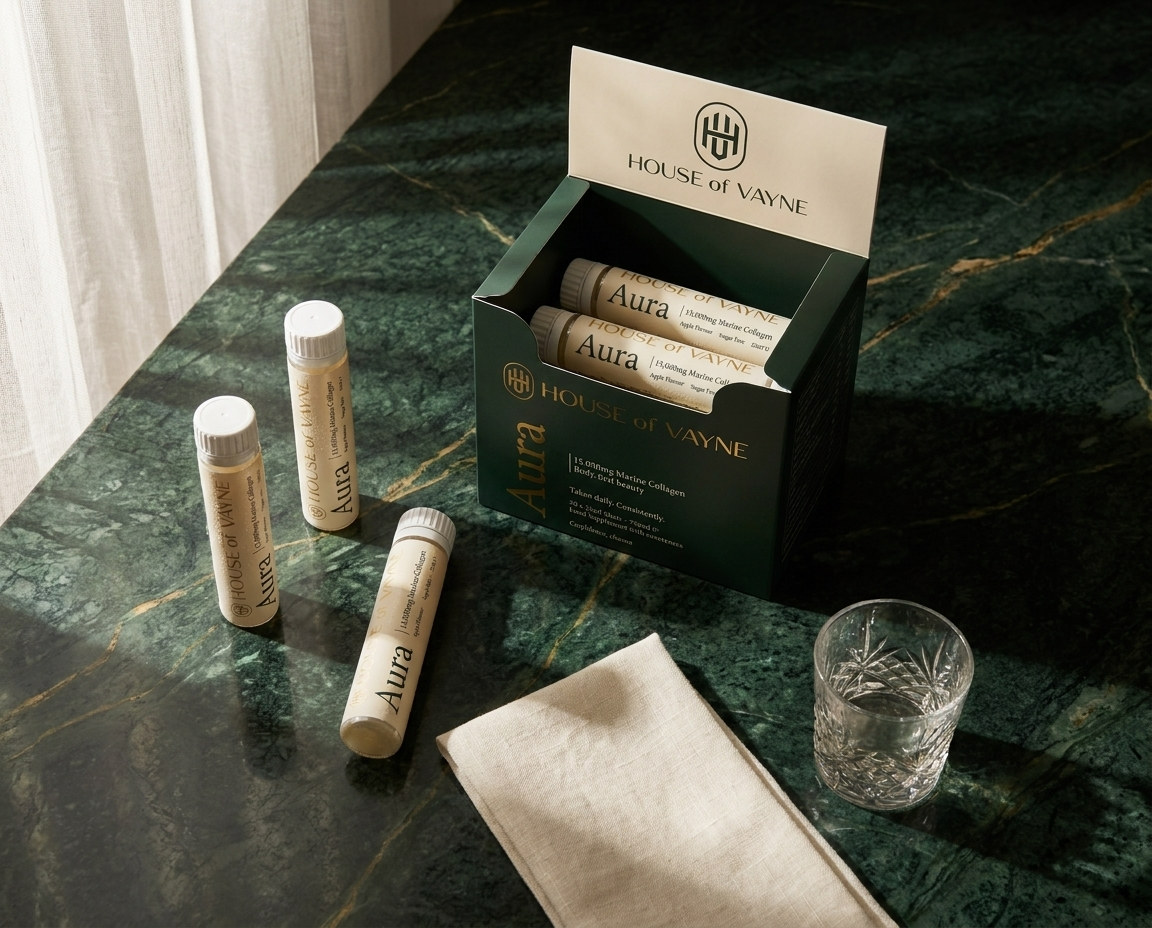
From a cost perspective, the per-day framing is useful. At £75 per month on subscription, Aura costs approximately £2.50 per day, less than a takeaway coffee. Whether that daily cost is justified depends on how much you value the measurable improvements in skin elasticity and hydration that the published research documents. For context: a single professional facial costs £100 to £200 and produces temporary results lasting days. Daily collagen produces ongoing, measurable structural improvements.
The honest position is this: if you stop taking collagen, you will gradually lose the improvements. This is not a marketing tactic. It is the biological reality of a supplement that works by maintaining elevated amino acid availability. If that ongoing commitment does not suit you, collagen supplementation may not be the right approach. But if you view it as a daily investment in structural maintenance, comparable to consistent exercise or a considered skincare routine, the value proposition is straightforward.
Read more: Is Expensive Collagen Worth It?
Can you maintain results with a lower dose after the initial period?
This is an area where the published evidence does not provide a definitive answer. No clinical trial has specifically tested a 'loading phase' at high dose followed by a 'maintenance phase' at lower dose. The dose-response relationship documented in the literature shows that higher doses produce stronger improvements, but it does not tell us whether a lower maintenance dose can preserve results initially achieved at a higher dose.
Theoretically, there is some logic to the approach. If your body has been supplemented at 15,000mg daily for three months and has achieved a higher baseline of collagen density, a lower dose might maintain that elevated baseline without further improvement. The lower dose would still need to exceed what your diet provides naturally. But this remains speculative, the evidence currently supports consistent high-dose supplementation as the most reliable approach.
The conservative recommendation based on available evidence is to maintain the dose that produced your results. If 15,000mg daily for 12 weeks produced measurable improvements, continuing at 15,000mg daily is the evidence-aligned approach for maintaining those improvements. Reducing dose introduces an unknown variable that could result in partial regression. Until research specifically tests maintenance protocols, maintaining the effective dose is the most defensible strategy.
Read more: 15,000mg Marine Collagen: Does Dose Actually Matter?
People Also Ask
Will my skin immediately look worse if I stop?
No. Changes are gradual, not immediate. The collagen your body synthesised during supplementation remains in place and degrades at normal rates. You will not wake up to visibly different skin the morning after your last dose. Regression happens over weeks to months, not days. Most people notice subtle changes in skin hydration first, followed by gradual changes in firmness over a longer period.
Can I take breaks from collagen and still see benefits?
Short breaks (a few days) are unlikely to affect results meaningfully because your body maintains amino acid pools that take time to deplete. Extended breaks (weeks) will begin to allow regression. The clinical evidence is based on consistent daily use, no published research supports an intermittent dosing protocol. For optimal results, daily consistency is the evidence-supported approach.
Is stopping collagen harmful in any way?
No. Stopping collagen supplementation has no adverse effects whatsoever. Your body simply returns to its natural rate of collagen production. You are not creating a dependency or altering your body's innate biology. You are merely removing an external source of amino acids that was supporting elevated production. There is no withdrawal, no rebound effect, and no risk associated with cessation.
How long do I need to take collagen to see lasting results?
There is no duration after which results become permanent without continued supplementation. Collagen works through ongoing maintenance, not cumulative permanence. The improvements documented in clinical trials are maintained by continued daily use. This is consistent with how collagen biology works, your body is continuously breaking down and rebuilding collagen, and supplementation supports the rebuilding side of that equation.
Key Takeaway: Collagen results are maintained by maintenance. When you stop supplementing, your body returns to baseline production, declining at 1 to 1.5% per year, and improvements gradually fade over weeks to months. This is biology, not marketing. Consistent daily supplementation maintains the elevated amino acid availability your fibroblasts need for sustained collagen synthesis. Aura is designed as a daily ritual precisely because the evidence supports ongoing use.
References
Reilly, D.M. & Lozano, J. (2021). "Skin Collagen Through the Lifestages: Importance for Skin Health and Beauty." Plastic and Aesthetic Research, 8, 2. DOI: 10.20517/2347-9264.2020.153
Viscomi, B., Muniz, M. & Sattler, S. (2025). "Managing Menopausal Skin Changes: A Narrative Review of Skin Quality Changes, Their Aesthetic Impact, and the Actual Role of Hormone Replacement Therapy in Improvement." Journal of Cosmetic Dermatology, 24(Suppl 4), e70393. DOI: 10.1111/jocd.70393. PMC12374573
Varani, J. et al. (2006). "Decreased Collagen Production in Chronologically Aged Skin." American Journal of Pathology, 168(6), 1861-1868. PMC1606623. Foundational data cited within Reilly and Lozano (2021).
Pu, S.Y. et al. (2023). "Effects of Oral Collagen for Skin Anti-Aging: A Systematic Review and Meta-Analysis." Nutrients, 15(9), 2080. PMC10180699
Bolke, L. et al. (2019). "A Collagen Supplement Improves Skin Hydration, Elasticity, Roughness, and Density." Nutrients, 11(10), 2494. PMC6835901
Brincat, M. et al. (1987). "Decline in Skin Collagen Content and Metacarpal Index After the Menopause and Its Prevention with Sex Hormone Replacement." British Journal of Obstetrics and Gynaecology, 94(2), 126-129. Foundational data for the postmenopausal rate, cited within Viscomi et al. (2025).


Leave a comment
This site is protected by hCaptcha and the hCaptcha Privacy Policy and Terms of Service apply.