

Article: How Long Does Collagen Take to Work? The 30, 60 & 90 Day Timeline
How Long Does Collagen Take to Work? The 30, 60 & 90 Day Timeline
The Short Answer: Collagen takes 4-6 weeks for early changes in nails and hair, and 8-12 weeks for measurable skin improvements. A 2023 systematic review of 26 randomised controlled trials found that supplementation beyond 8 weeks produced significantly better outcomes than shorter periods (Pu et al., 2023). There are no overnight results — collagen works by accumulation.
What happens in the first four weeks of taking collagen?
During the first month of collagen supplementation, your body embarks on a sophisticated process of breaking down hydrolysed collagen peptides into individual amino acids and small dipeptides. These molecular fragments are absorbed through the intestinal wall and enter your bloodstream, where they begin circulating to tissues throughout your body. The tissues most responsive to this influx are those with active collagen synthesis — primarily your skin, hair, nails, and connective tissue structures. This initial phase is fundamentally about creating the raw material your body needs to build and repair collagen structures.
Read more: What Collagen Actually Does for Your Skin, Hair and Nails
Most people notice nothing visible during week one, which can be discouraging for those expecting rapid results. However, critical work is happening at the cellular level. Your body is systematically building up circulating pools of amino acids, particularly glycine, proline, and hydroxyproline — the signature amino acids that define collagen's molecular structure. These amino acids accumulate in your bloodstream and tissues, establishing the foundation for more visible changes to come. This accumulation phase is essential, though entirely invisible to the naked eye.
The first tangible signs of change tend to appear in nails and hair, which are faster-growing tissues than skin. Nails grow continuously from the nail matrix and respond relatively quickly to improved amino acid supply because they are constantly being synthesised and extruded. Some users report stronger, less brittle nails by weeks 3-4 as the collagen peptides provide the amino acid substrates needed for stronger keratin formation. Hair texture improvements — reduced breakage, increased body and shine, less frizz — can start appearing around the same timeframe for similar reasons. These tissues have rapid turnover rates, making them early indicators of systemic collagen status.
The supporting micronutrients in your collagen supplement matter significantly here. Biotin, included in most premium formulations, contributes to the maintenance of normal hair and nails — this is an EFSA-authorised claim based on published evidence. Zinc contributes to normal skin, hair, and nails. These micronutrients work synergistically alongside the collagen peptides, providing cofactors that enable amino acid utilisation. Consistency is the single most important factor during this initial phase. A supplement taken every evening over 30 days will outperform the same supplement taken sporadically over 60 days, because you are creating a sustained elevated level of circulating collagen-derived amino acids rather than intermittent spikes.
Read more: What Is in Aura? Every Ingredient Explained
When do visible skin changes start appearing?
Skin changes lag behind nails and hair because dermal collagen turnover is inherently slower. The dermis — the structural layer of skin where collagen resides — replaces itself over a significantly longer biological cycle than rapidly growing tissues like nails. Skin cells in the dermis are not continuously being shed and replaced in the way that nail matrix cells or hair follicle cells are. Instead, collagen undergoes a slower remodelling process where existing collagen is gradually broken down and replaced with newly synthesised collagen. This fundamental difference in tissue turnover rate explains why skin takes longer to show visible improvements despite receiving the same amino acid supply as your nails and hair.
Between weeks 4 and 8, some people begin to notice their skin feels noticeably more hydrated. This may not immediately represent entirely new collagen, though improvements are beginning at the cellular level. What people are often detecting is increased water retention in the dermal matrix as the extracellular environment improves. As collagen peptides accumulate and new collagen synthesis begins, the extracellular matrix becomes more stable and retains moisture more effectively. Skin may appear slightly plumper, particularly around the cheeks and under-eye area where loose skin is most noticeable. The skin's surface texture often improves as hydration increases, and some people report that fine lines appear less pronounced as skin plumpness increases.
The clinical research supports observable change in this timeframe. A 2019 study by Bolke and colleagues measured skin hydration, elasticity, roughness, and density in participants taking hydrolysed collagen compared to placebo. By 8 weeks, there were statistically significant improvements in hydration and elasticity in the collagen group compared to placebo (Bolke et al., 2019). This represents the minimum timeframe for measurable, clinically validated skin change. The changes observed were not marginal — they represented genuine quantifiable improvements in skin barrier function and mechanical properties.
What does the research show at 8-12 weeks?
The 8-12 week timeframe is where clinical evidence becomes genuinely compelling. Multiple randomised controlled trials consistently show measurable improvements in skin elasticity and hydration at this duration, representing the point where collagen supplementation produces results that even skeptical dermatologists accept. Reilly et al. (2024) conducted a rigorous study with proper controls and found a 22.7% increase in skin elasticity and 13.8% increase in skin hydration after 12 weeks of 8,000mg daily supplementation. Bio Basic Europe (2022) reported similarly impressive results: a 17.1% increase in skin elasticity and 20.6% increase in skin moisturisation after just 56 days (8 weeks) at 10,000mg daily. These are not marginal improvements — they represent clinically significant changes in skin mechanics.
A systematic review by Pu et al. (2023) analysing 26 randomised controlled trials with a combined 1,721 participants confirmed a critical finding: long-term supplementation (greater than 8 weeks) produced significantly more favourable outcomes than short-term supplementation. This meta-analysis approach, which pools data from many studies, provides high-quality evidence that the 8-12 week timeframe is genuinely meaningful. The review confirmed that collagen supplementation is not a placebo effect — the improvements are real, measurable, and statistically significant. The authors also noted that higher doses within the tested range produced better outcomes, establishing a clear dose-response relationship.
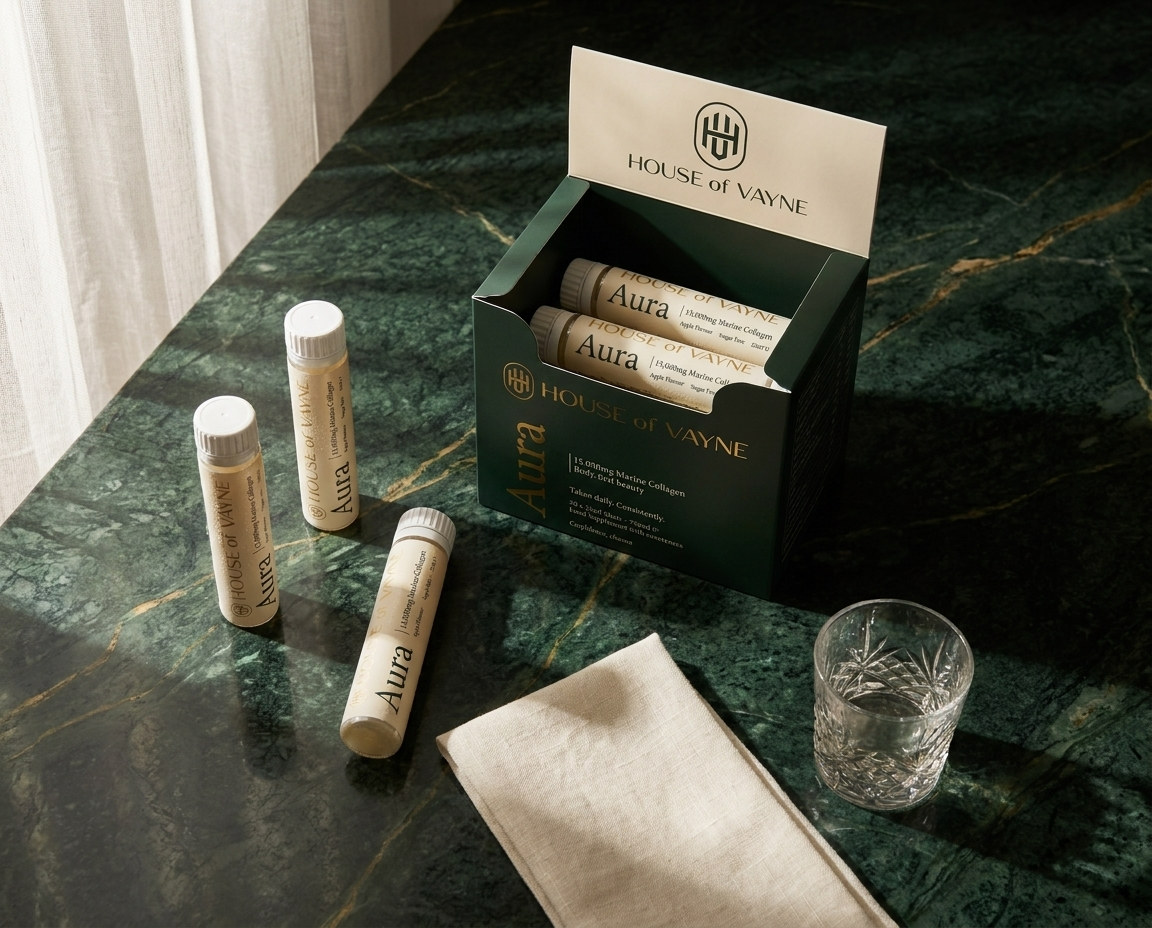
Aura delivers 15,000mg of marine collagen per shot — substantially exceeding the doses used in every published clinical trial. While no study has specifically tested 15,000mg in isolation, the consistent pattern across all existing research shows that higher doses within the tested range (2.5g to 10g daily) produce stronger quantified improvements in both elasticity and hydration. Extrapolating from this clear dose-response relationship, a 15,000mg dose would theoretically exceed the benefits observed in the published trials. This positions premium-dosed supplements like Aura at the frontier of what evidence suggests is possible from oral collagen supplementation.
Read more: 15,000mg Marine Collagen: Does Dose Actually Matter?
Does evening timing make a difference?
Collagen synthesis — the physiological process by which your body constructs and repairs structural collagen — peaks during deep sleep. This is established human physiology, not a marketing claim. Growth hormone rises during deep sleep stages, fibroblasts in the dermis activate their collagen-producing machinery, and the structural repair and building work happens overnight. Your body has evolved to conduct major tissue repair and remodelling during sleep because that is when cortisol is low, growth hormone is elevated, and energy is available for protein synthesis. This is why athletes recover best with adequate sleep, why wounds heal faster in people with good sleep, and why chronic sleep deprivation accelerates aging.
By taking collagen in the evening, the hydrolysed collagen peptides are absorbed and circulating in your bloodstream during the exact window when your body is most actively building collagen. The timing works with your body's natural circadian repair cycle rather than against it. Your fibroblasts — the cells in the dermis that synthesise collagen — are most responsive to amino acid availability during the night when growth hormone is elevated and they are most active. This is fundamental biochemistry: substrate availability (the amino acids from collagen peptides) meets enzymatic capacity (the activated fibroblasts) during the optimal window.
This is why Aura is specifically designed as an evening ritual rather than a morning supplement. Most collagen brands default to morning dosing without any scientific rationale — they are simply following convention. Evening timing aligns supplementation with your body's natural repair biology, optimising the utilisation of the peptides you are consuming. The evidence on timing is not yet extensive, but the underlying physiology is solid, and anecdotal reports from users suggest that evening dosing produces more noticeable results than morning dosing of identical formulations.
Read more: Collagen After 30: Why Your Skin Needs More Than Skincare
People Also Ask
Can I see results faster than 8-12 weeks? Nails and hair may show observable changes by week 4-6, but skin elasticity typically requires 8-12 weeks of consistent daily use to produce measurable improvements. Higher doses may show results slightly faster, and individual factors like sleep quality and hydration status also affect the timeline. Genetics play a role — some people's bodies respond faster to collagen supplementation than others.
What if I stop taking collagen after seeing results? Collagen supplementation maintains elevated amino acid availability for collagen synthesis. If you stop supplementing, your body returns to its baseline rate of collagen production — which declines by approximately 1-1.5% per year. The improvements you've achieved remain temporarily, but without continued supplementation, you will gradually return to your previous collagen status. Results are not permanent without continued supplementation.
Does it matter what time in the evening I take it? Any time in the evening works biologically. The goal is to have peptides circulating during your sleep window when collagen synthesis is peak. Taking collagen 30-60 minutes before bed as part of your wind-down routine is a practical approach that creates consistency and pairs supplementation with sleep.
Why do some brands claim results in 2 weeks? Most brands claiming 2-week results are relying on marketing rather than science. The peer-reviewed evidence consistently shows that meaningful, measurable skin changes require a minimum of 8 weeks. Nail and hair changes can appear earlier (4-6 weeks), but skin elasticity improvements under 4 weeks are not supported by any published clinical trials. Claims of faster results are marketing positioning, not biology.
Key Takeaway: The research is consistent: collagen works by accumulation, not overnight. Nails and hair respond first (4-6 weeks), skin follows (8-12 weeks). The key variables are dose, consistency, and timing. Aura delivers 15,000mg per evening shot — designed to work with your body's overnight repair cycle.
Read more: Liquid Collagen vs Powder vs Tablets: Absorption Compared
References
Pu, S.Y. et al. (2023). "Effects of Oral Collagen for Skin Anti-Aging: A Systematic Review and Meta-Analysis." Nutrients, 15(9), 2080. PMC10180699
Bolke, L. et al. (2019). "A Collagen Supplement Improves Skin Hydration, Elasticity, Roughness, and Density: Results of a Randomized, Placebo-Controlled, Blind Study." Nutrients, 11(10), 2494. PMC6835901
Reilly, D.M. et al. (2024). "12-Week Oral Intake of Hydrolysed Collagen." Dermatology Research and Practice. PMC11254459
Bio Basic Europe (2022). "Evaluation of Efficacy of a Hydrolyzed Collagen Supplement." Nutrients. PMC8944283

Leave a comment
This site is protected by hCaptcha and the hCaptcha Privacy Policy and Terms of Service apply.