

Confidence and Vanity
Appearance and self-perception: what the research shows.
The relationship between physical appearance and psychological wellbeing is one of the most studied areas in social psychology. The evidence is consistent: how people perceive their own appearance significantly affects their confidence, social behaviour, and performance.
Self-perception theory, first proposed by Daryl Bem in 1972, suggests that people infer their own attitudes and emotions partly from observing their own behaviour and appearance. When you invest in your appearance and see the results, your brain updates its model of who you are. This is not superficiality. It is a well-documented cognitive process.
A meta-analysis published in Psychological Bulletin found a moderate positive correlation between self-rated physical attractiveness and self-esteem. The relationship was consistent across age groups, gender, and cultural contexts.
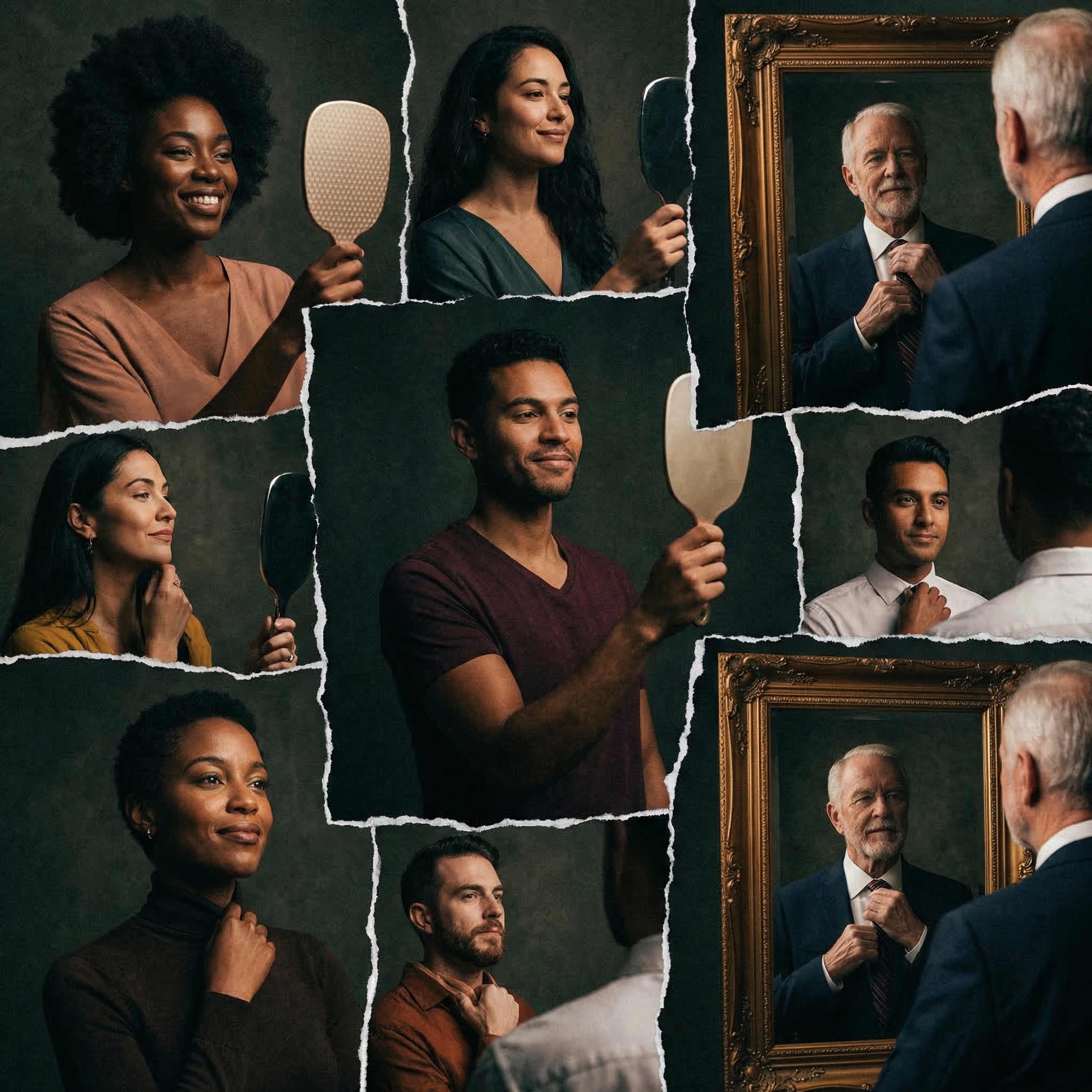
Enclothed cognition and embodied self-image
The concept of “enclothed cognition”, first demonstrated by Adam and Galinsky in 2012, showed that wearing specific clothing changes cognitive performance. Participants wearing a lab coat described as a doctor’s coat performed significantly better on attention tasks than those wearing the same coat described as a painter’s coat.
This principle extends beyond clothing. Grooming behaviour, skin quality, and attention to appearance create embodied feedback loops. When the body signals health and attention, the brain processes this as evidence of competence and control. The effect is measurable in behaviour: improved posture, increased eye contact, greater willingness to speak in group settings, and higher self-reported confidence.
Investing in your physical appearance is not a compensatory behaviour. It is a form of environmental self-regulation. Curating the signals your body sends to your own brain.
The halo effect and social perception
The halo effect, first identified by Edward Thorndike in 1920, describes the cognitive bias where positive impressions in one area (such as physical appearance) influence judgements in unrelated areas (such as competence, trustworthiness, and intelligence).
Decades of research confirm this bias operates consistently and unconsciously:
| Finding | Study context | Implication |
|---|---|---|
| Attractive individuals receive higher salary offers | Labour economics research across multiple industries | Appearance influences professional outcomes independent of qualifications |
| Teachers rate attractive students as more intelligent | Education psychology studies with controlled photo ratings | Appearance biases begin in childhood and affect developmental opportunities |
| Attractive defendants receive more lenient sentences | Judicial decision-making research | Appearance affects perceptions of character and culpability |
| Groomed individuals are perceived as more competent | Workplace perception studies | Grooming signals attention to detail, which generalises to professional competence |
Acknowledging the halo effect is not endorsing it. It is recognising a documented reality of human social cognition. People who invest in their appearance are not being superficial. They are navigating a world in which appearance demonstrably affects outcomes.

Grooming behaviour and mental health.
Clinical psychology recognises grooming behaviour as both an indicator and a modulator of mental health. Reduced grooming is one of the earliest behavioural markers of depression. Conversely, re-engagement with grooming routines is a recognised early indicator of recovery.
This is not coincidental. Grooming activates the brain’s reward circuitry. The act of attending to your appearance triggers dopamine release associated with goal-directed behaviour. The result, seeing an improvement in appearance, reinforces the behaviour through positive feedback.
Consistency is key. A single grooming act produces a temporary mood boost. A sustained routine produces lasting changes in self-perception. The neuroscience supports what intuition already suggests: taking care of yourself, consistently, changes how you feel about yourself.
Why we use the word vanity.
The word “vanity” carries cultural baggage. It implies excess, narcissism, superficiality. But its original meaning was simply “self-regard”. The act of seeing and attending to oneself.
House of Vayne reclaims this word deliberately. The psychological and neuroscientific evidence is clear: attending to your appearance is associated with higher self-esteem, improved social outcomes, better mental health indicators, and greater professional confidence. Dismissing this investment as vanity ignores decades of research.
We define vanity as self-respect, empowerment, honesty, and pride. These are not marketing terms. They are descriptions of what the research consistently shows when people invest in their own appearance with intention and consistency.
Confidence is not innate. It is built through deliberate choices. What you put into your body, how you maintain your routines, how you present to the world. The science supports this. The results confirm it.